Furniture and home7 min read
Augmented Reality Furniture Shopping: Benefits and Costs
How 3D and AR help a furniture shop at each step of the sale, from search to delivery, with the return figures behind it and what it costs.
By CharpstAR · 21 Mar 2023 · Updated 14 Oct 2026
Part of Augmented reality for furniture retail: the complete guide

A couple are choosing a corner sofa on your site.
They have it open on two phones. One of them is sure it fits along the long wall, the other thinks the chaise will block the balcony door. Neither knows whether the grey fabric is the cool grey of the photo or something warmer. They measure the room twice and still aren't certain, so they decide to wait until the weekend and visit a store, maybe yours, maybe someone else's.
Each of those doubts is a chance to lose the sale or to get the sofa back after delivery. Furniture returns are expensive. Eightx's 2025 benchmarks put one large return at 55 to 108 dollars to process, before the lost sale. 3D and augmented reality (AR) answer the doubts on the product page. With CharpstAR, the couple can turn the sofa, switch fabrics on the same model and stand it in their living room at real size from the phone, with nothing to install.
What Is Augmented Reality Furniture Shopping?
It's a set of tools on your furniture product pages, all running from one 3D model of each product:
- A 3D product viewer that customers turn and zoom, with the measurements drawn on the model and hotspots for seat depth, filling and leg material
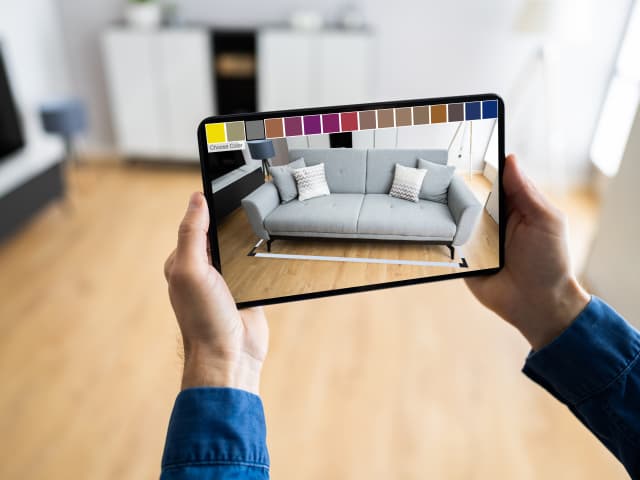
- A 3D product configurator for fabrics, legs, widths and modules, which only offers combinations you can make
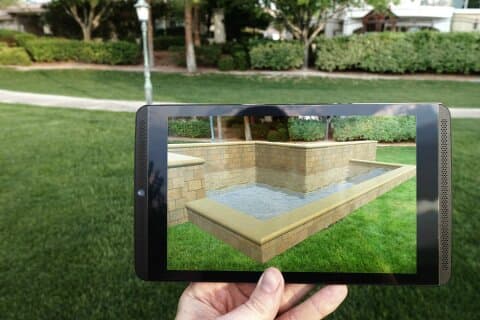
- View in AR, which places the product at real size in the customer's room through the phone camera
- Rendered product images from the same model, for category pages, campaigns and new fabrics
Why Use 3D and AR to Sell Furniture Online?
Fewer Returns From Size and Space
In the same Eightx benchmarks, online furniture returns run at about 22.7 percent, against a 19.3 percent average across categories, and roughly 58 percent of furniture returns come from size and space: the piece is larger than expected or doesn't fit. AR placement deals with that exact reason before checkout. Gunner Kennels, in Shopify's case study, saw returns fall 5 percent and conversion rise 40 percent after adding 3D and AR.
AR can't check the stairwell on delivery day, so keep the packed dimensions on the page as well.
Fewer Returns From Colour and Material
Colour and material that don't match the screen are the next reason, at about 44 percent in the same Eightx benchmarks, which take that figure from a 2025 YouGov survey of retail more broadly. Showing every fabric on the same model, under the same light, lets customers compare fabrics with each other. It doesn't fix screen calibration, so for an expensive piece 3D narrows the choice to two or three fabrics and a posted swatch settles it.
Higher Conversion on the Product Page
Shopify's merchant data put conversion 94 percent higher on interactions with 3D or AR content than without. Shoppers who use the viewer are already the interested ones, so read that as a ceiling. Use your own before-and-after numbers to see the lift on your products.
Customers Find You in Search With a 3D Badge
Google lets merchants attach a 3D model to a product listing, so in supported markets and categories the listing carries a 3D badge and a view in your space option in Search. Pinterest's Try On for Home Decor let shoppers place items from Crate & Barrel, CB2, Walmart, West Elm and Wayfair in their room from a Pin, across more than 80,000 shoppable Pins at launch, and Pinterest reported that Pinners were five times more likely to purchase from Try On Pins than from standard Pins. Merchants without a 3D model file can't use Google's option.
Fewer Photo Shoots for New Fabrics
Once the model is the master file, a new fabric is added to it and the images are rendered. At MELIMELI, the 3D and AR work also supports the team's image generation, alongside letting customers explore sofas across fabrics and test them at home with AR.
Use Case: A Modular Sofa
Most sofas, beds and storage are sold in combinations, and modular sofas have the most. Sweef sells one whose layouts are hard to explain in photos. We turned Sweef's existing 3D files into a modular configurator with AR, so the customer sees the exact layout they're building and can stand it in their room. Sweef's founder described the result: "For us, the value was in making a complex modular product feel simple for the customer."
How It Works for the Customer
- They find the sofa in search or on a category page with rendered images
- On the product page, they turn it in 3D and read the measurements on the model
- They add modules, pick a fabric and legs, and the sofa on screen changes with each choice
- On a phone, they press View in AR and place that layout in their living room at real size
- They walk round it, check the gap to the door, and add it to the cart
A configurator is only as good as its rules. If it allows a combination your factory can't make, the order gets cancelled, so we set the rules up with you before launch.
How We Add 3D and AR to a Furniture Shop
Step 1: Pick the Product That Costs You Most in Returns
Usually that's the largest or the most configurable piece. Send us its product page, and we model it in 3D with AR as a free sample.
Step 2: You Get a Quote for the Range
We reply within a working day with what the rest of the range needs.
Step 3: Models, Fabrics and Rules
We build the models from your photos, CAD files or existing 3D files, add your fabrics and finishes, and set up the configurator rules. You check everything on your own pages before launch.
Step 4: Publish on Your Product Pages
A snippet puts the viewer on Shopify, Shopware, Magento, WooCommerce or a custom-built site, and we help with placement. Orders still go through your own checkout. If the shop runs on Shopware, the setup for a configurator on Shopware is on its own page.
Furniture KPIs to Track
| KPI | What to measure |
|---|---|
| Return rate | Whether fewer pieces come back for size, space, colour or material |
| Conversion rate | Whether products with 3D and AR sell to more visitors than similar products without |
| Average order value | Whether customers add modules, upgrades and premium fabrics in the configurator |
| AR use | How many mobile visitors place the piece in their room, and how many of them order |
| Customer service emails | Whether fewer customers ask about measurements and combinations |
| Image production costs | How many fabric shoots the renders replace |
Measure the product page for a month before launch and a month after, and give returns a full return window.
What Does It Cost a Furniture Shop?
A sofa or bed range with fabric and colour choices sits on the Value plan: from 20 dollars per model per month, minimum 100 models over 24 months, including colour and texture configurators, custom dimensions, annotations and rendered product images. Single products with a viewer and AR start on the Basic plan at 10 dollars per product per month, minimum 100 variants over 12 months. Both cover the models, hosting, updates and implementation.
Modular sofas and storage systems are priced per range, after we've seen the modules and rules. No setup fee is charged, and the free sample is your first product.
Is It a Good Fit for Your Furniture Business?
3D and AR tend to pay back fastest for:
- Sofas, beds and tables that customers worry won't fit
- Modular furniture with more layouts than you could photograph
- Ranges with many fabrics, where colour causes returns
- Shops with high delivery and collection costs per return
- Brands selling mostly online, without showrooms near every customer
Start With Your Most Returned Product
Put your most returned piece through every step above and compare its numbers with the month before.
Tell us which product it is and we'll come back within a working day, or try the sofa and the other furniture in our configurator demos.
Sources
- Google Merchant Center Help, Display your products in 3D and augmented reality.
- Pinterest Newsroom, Pinterest introduces AR Try On for Home Decor, January 2022.
- Shopify, merchant data on 3D and AR content, September 2020 and AR shopping: Rebecca Minkoff and Gunner Kennels results.
- Eightx, Furniture and home return rate benchmarks 2025.
- National Retail Federation and Appriss Retail, 2023 Consumer Returns in the Retail Industry.
- CharpstAR prices, read on 14 October 2026. https://charpstar.co/prices