Furniture and home3 min read
An app or a page button for AR interior design shopping
A room-design app and an AR button on the product page do different jobs. What each asks of the shopper, what it costs, and which retailers need which.
By CharpstAR · 21 Mar 2023 · Updated 30 Sept 2026
Part of Augmented reality for furniture retail: the complete guide
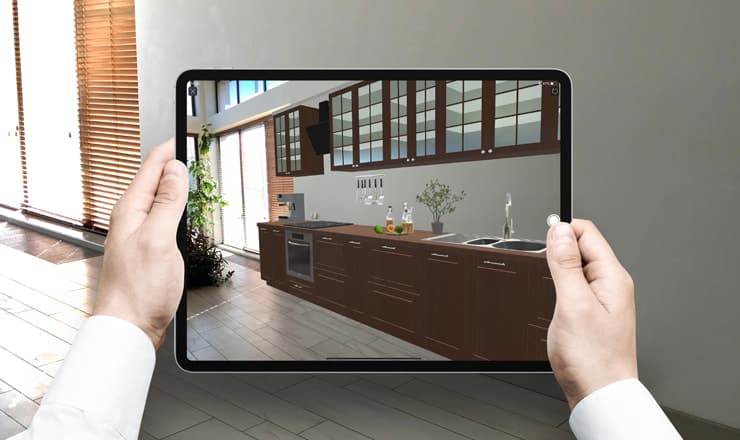
A home retailer can offer AR as a dedicated interior design app or as a button on the product page. The app has to be downloaded first; the shopper then scans the room, browses a catalogue inside it, arranges furniture, saves the layout and can buy from there. The button sits on the product page. A shopper looking at a lamp taps "view in your room", sees it at real size through the camera, and decides on the same page. The glossary explains the view in room button and what the model needs for it.
For most retailers the button is the better use of the budget.
What each asks of the shopper
A dedicated app has to be installed before the shopper gets anything from it, and part of the audience stops there. The room scan that follows loses more. After that the shopper browses a catalogue in a second interface, often somewhere other than where they planned to buy.
On the product page it takes one tap. The shopper is already on your site, interested in one product and close to deciding, and the AR view opens on the page where the doubt about size came up.
The button also costs less to build, and its effect shows in the conversion rate you already track.
Shopify cites a Clutch survey of shoppers in which 58 percent said they use AR before making a purchase.
AR without an app on Android and iPhone
The button is possible because both mobile platforms dropped the app requirement. Android's Scene Viewer displays web-hosted glTF 2.0 or GLB models in the camera view on ARCore-supported devices running Android 7.0 or later. Apple's AR Quick Look shows USDZ files in Safari, Messages, Mail and Notes on iPhone, iPad and Vision Pro, from iOS 12 onwards.
The retailer exports one model in both formats and adds the button.
Lighting
Floor lamp
Black metal.

A 135 cm floor lamp as it appears on a product page.
When a dedicated app is the right choice
IKEA has one because a shopper can furnish a whole room from its range, and most retailers' ranges are too narrow for a planner to be useful. Kitchens, wardrobes and modular storage are sold as layouts, and working out a layout takes an hour that shoppers are willing to spend, so a slower planning tool suits that purchase. Where a retailer offers a design service in the store or at home, the designer runs the app with the customer, and it only has to be installed on the designer's device.
What the AR button needs to work
The dimensions have to be true, because the shopper opens the view to check size.
Google's Scene Viewer documentation puts the model size at 10 MB, with a recommended limit of 100,000 triangles and no more than ten materials. Over that size the model takes too long to appear on mobile data.
If the shopper picked the green fabric, the model in the room has to be green.
AR lighting estimation is good enough to judge whether a shade looks warm or cool in a room. It can't match an existing piece exactly, so say so on the page and offer a swatch.
| Dedicated interior app | AR on the product page | |
|---|---|---|
| Steps before the shopper sees anything | Install, then room scan | None, one tap |
| Where it sits in the funnel | Discovery and planning | The decision point |
| Build cost | High, plus ongoing app maintenance | Model production plus a snippet |
| Measurable against | App installs and sessions | Conversion and return rate you already track |
| Needs a big catalogue | Yes, to be useful | No, works with one product |
| Best for | Large ranges, kitchens, design services | Most other retailers |
What our clients use
Our clients are mid-size brands and none of them has a room planner. Sweef sells modular sofas; the shopper builds a layout in a browser configurator and places it in the room from that same page. Each product has one accurate model on its own page.
Sources
- Google, Scene Viewer documentation.
- Apple, AR Quick Look.
- Shopify, AR shopping, including the AR usage figure.