3D for e-commerce3 min read
Whether your business should use augmented reality
Six questions that show whether AR is worth the money for your products, what to do if the answer is no, and how to run a first test you can measure.
By CharpstAR · 4 Oct 2023 · Updated 9 Oct 2026
Part of Augmented reality for furniture retail: the complete guide

For many catalogues AR won't pay back what it costs. These are the six questions we ask a retailer before we quote. A yes to the first three usually means the case is good, and a no to either of the first two means you can stop there.
1. Does your shopper hesitate over size, space or material?
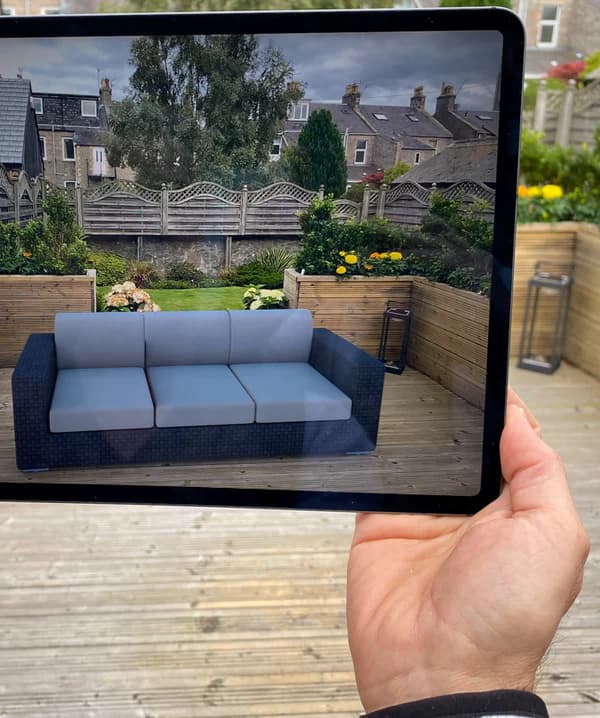
AR shows how an object looks at its real size in a room or on a face, and that's the only question it answers. It does nothing for doubts about price, specification, delivery time or trust in the brand.
It suits products people hesitate over for size, such as sofas, stoves, wardrobes and glasses.
2. Is the product rigid enough to model accurately?
A 3D model has to look like the product you ship. Hard goods with defined geometry model well. Fabric on a moving body is far harder. A model can't tell the shopper how heavy the product is or what the fabric feels like.
3. Is the order value high enough?
Our pricing starts at 10 dollars per product per month on Basic, twelve-month term with a minimum of 100 variants, and from 20 dollars per model per month on Value with a twenty-four month term. Compare the fee with your margin per unit. A product with a 400 dollar margin covers it with one extra sale; a 6 dollar product needs many.
Count returns in the calculation too. In 2023 the National Retail Federation and Appriss Retail put the US online return rate at 17.6 percent.
4. Is your product page otherwise in good shape?
This is where most retailers we talk to find they aren't ready. Baymard's list of cart abandonment studies, updated in September 2025, puts the average rate at 70.22 percent across 50 studies. In its latest survey of reasons, the leading ones are extra costs at checkout at 40 percent, slow delivery at 20 percent, not trusting the site with card details at 19 percent and forced account creation at 18 percent.
Shipping shown for the first time at the last checkout step counts as an extra cost, and a 3D model on the product page reaches none of the four.
5. Can you measure the result?
If a product gets so little traffic that a good week and a bad week look the same, you won't be able to tell whether AR worked.
You need enough sessions on a product to compare a month with and a month without, or to compare a group of products with models against a comparable group without. In our experience a few hundred sessions per product per month is the floor.
6. Do you have someone who can put it on the page?
The delivery side is a small job. Both phone platforms open web AR from a product page, so the work is adding a `
When the answer is no
If your products are low-margin, or nobody hesitates before buying them, AR won't pay back. The same goes if your checkout loses a lot of shoppers or you have no way to measure the result. If you're about to replatform, the integration will have to be done again on the new platform.
Quotes for a custom AR app describe a different product. Shopify's guide puts a custom AR app at 30,000 to 50,000 dollars for a basic one and up to 300,000 dollars for a complex one. Putting AR on an existing product page uses the phone's own viewer, so those figures don't apply.
A first test
Start with one product. Put a model on the product with the highest value and the most hesitation, leave it up for a month, and compare it against a similar product without one. The difference between the two is your own figure.
Sources
- National Retail Federation and Appriss Retail, 2023 Consumer Returns in the Retail Industry.
- Baymard Institute, cart abandonment rate statistics and reasons.
- Shopify, AR shopping, including AR app cost ranges.