3D for e-commerce4 min read
Using augmented reality to sell large sports equipment
How AR placement helps shoppers judge the size of a rower, a bike or a tent at home, where it falls short on fit, and which products to model first.
By CharpstAR · 4 Oct 2023 · Updated 22 Sept 2026

A lot of sports equipment is big, and most of it is bought online without anyone seeing it first. From a product photo a shopper can't tell where it will go or how big it really is. A rowing machine is 2.4 metres long. A kayak on a wall rack takes over a good part of the garage, and a road bike needs a hallway wide enough to turn it round.
Showing a correctly scaled object in a room is something augmented reality does well. It's a separate job from the try-on features that get most of the coverage, and try-on comes up further down.
Judging the space at home
For anything bigger than about a metre in any direction, the shopper's doubt is usually about the room. Will it fit between the sofa and the wall, and where does it go when nobody's using it?
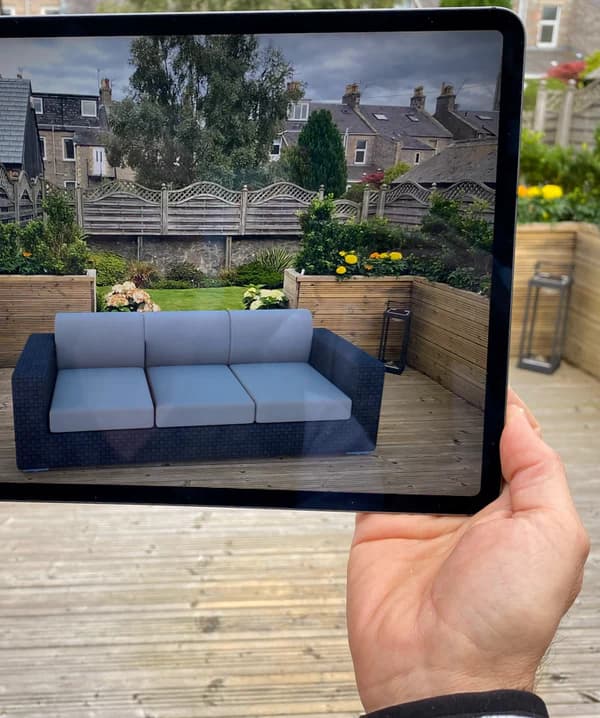
A dimensions table gives a rough answer. AR lets the shopper stand the product in their own room through the phone camera and walk around it. It opens with one tap from the product page and needs no app.
It matters most in these categories:
- Cardio equipment: treadmills, rowers, exercise bikes and ellipticals. They're large and usually bought for one particular corner of one room.
- Racks, benches and home gym frames, where ceiling height is the thing to check.
- Bikes, where the questions are storage and transport, and whether the frame is the size the shopper pictured.
- Tents and camping gear. A tent packed and a tent pitched are very different sizes, and the photos usually show only one of them.
- Table tennis and pool tables, basketball hoops, trampolines and other large recreation gear.
Sport
Paddleboard
Inflatable, 10 ft.

An inflatable paddleboard, about 3 m long. Switch the dimensions on, and on a phone lay it on the floor at true size.
Fit for wearable gear
AR is much weaker with wearable sports gear. Helmets, shoes, gloves and packs fit according to the shape of a body part measured to the millimetre, and a phone camera can't measure that reliably. Face tracking is good enough to show the shape of a helmet or a pair of sports sunglasses on the shopper, which is useful for choosing a style, but it won't tell anyone their size.
For wearables, a well-made 3D model with proper zoom does more. Up close, a shopper can study the sole pattern, the strap adjustment or the vents in a way a photo set rarely allows, on any device and without giving camera permission.
| Product | AR placement | Face or body try-on | 3D viewer with zoom |
|---|---|---|---|
| Treadmill, rower, rack | Decisive | Not applicable | Useful |
| Bike | Useful for storage and scale | Not applicable | Decisive for components and finish |
| Tent | Decisive, pitched footprint | Not applicable | Useful |
| Helmet | Weak | Useful for shape and style | Decisive |
| Running shoe | Weak | Weak | Decisive |
| Kayak, board | Decisive | Not applicable | Useful |
| Dumbbells, small accessories | Low value | Not applicable | Useful |
What the published evidence covers
We haven't found a published dataset on AR for sports equipment specifically. The closest published case is Gunner Kennels, which sells a large hard-sided product where the size in the room is the main buying question. It reported 5 percent fewer returns after adding AR.
Freight makes returns in this category expensive, since a treadmill that comes back has to be collected on a pallet.
What it takes to build
The build is the same as in any other category. Each product needs an accurate 3D model, exported as GLB for the web and Android and as USDZ for iOS and hosted on a CDN, plus a viewer component in the product page template. Google recommends keeping Scene Viewer models under 10 megabytes with textures at 2048 by 2048 or smaller. Most equipment fits within that when the model is built for the web; a file exported straight from CAD usually won't. Formats, hosting and the cost per product are on solutions and prices.
Large equipment has one modelling trap. Most cardio machines and every tent have a folded and an unfolded state, and the model needs both. A treadmill modelled only in the running position can't show how much floor it takes up when it's folded away, and that's usually what the shopper wants to know. Model both states and give the shopper a switch.
Choosing the first products
Take the ten products with the highest return rate or the most pre-sale questions about size. They're nearly always the large ones. Send one of them with photos and measurements through the sample page to check the model on your own product page. Then model the rest, add a 3D viewer and an AR button to their pages, and compare their returns and conversion with the rest of the catalogue over a full quarter.
Sources
- Shopify, merchant data on 3D and AR content, September 2020.
- Shopify, AR shopping, including the Gunner Kennels returns result.
- National Retail Federation and Appriss Retail, 2023 Consumer Returns in the Retail Industry.
- Google, Scene Viewer model guidelines.