3D for e-commerce3 min read
Augmented reality on social media and what shoppers share
What AR content shoppers share on Snapchat, Instagram and Pinterest, what brands have got from it, and what a brand without a lens budget can do instead.
By CharpstAR · 4 Oct 2023 · Updated 22 Sept 2026

Most people know augmented reality from social media filters, so a product brand's shoppers already know what AR is and expect it to work from a phone camera without instructions. The brand has to decide whether a sponsored lens is worth the money, and if it isn't, what a smaller brand can put out that still gets shared.
Why shoppers share AR pictures
AR puts the brand's product into the shopper's own picture, and the shopper posts it for their own reasons. The Deloitte Digital and Snap study of 15,000 consumers found that 74 percent expected AR to be more important in their lives over the next five years, and that companies with branded AR experiences were 41 percent more likely to be considered.
What Snapchat, Pinterest, Instagram and TikTok offer
Snapchat
Gucci's 2020 shoe try-on was Snapchat's first global shoppable AR campaign. It drew four sneaker styles onto shoppers' feet, had a shop button in the lens and ran in eight countries.
Try On for Home Decor launched in January 2022 across more than 80,000 shoppable Pins from Crate & Barrel, CB2, West Elm, Wayfair and others. A Pinner places the product in their room straight from the Pin. Pinterest reported that Pinners were five times more likely to buy from Try On-enabled Pins than from standard ones.
Instagram and TikTok
Both offer effects and filters of the same kind, and brands usually have an agency build them as sponsored effects. A brand without that budget can still post 3D renders and short clips on Instagram and TikTok made from the same product model.
What a sponsored lens costs
A sponsored lens or effect at national scale is a media buy with production costs on top, which puts it within reach of brands that already have a media budget of that size. Luxury houses and mass-market beauty brands use the format. A furniture or eyewear brand with a three-person marketing team is better off starting with AR on its own product pages.
AR on your own product page
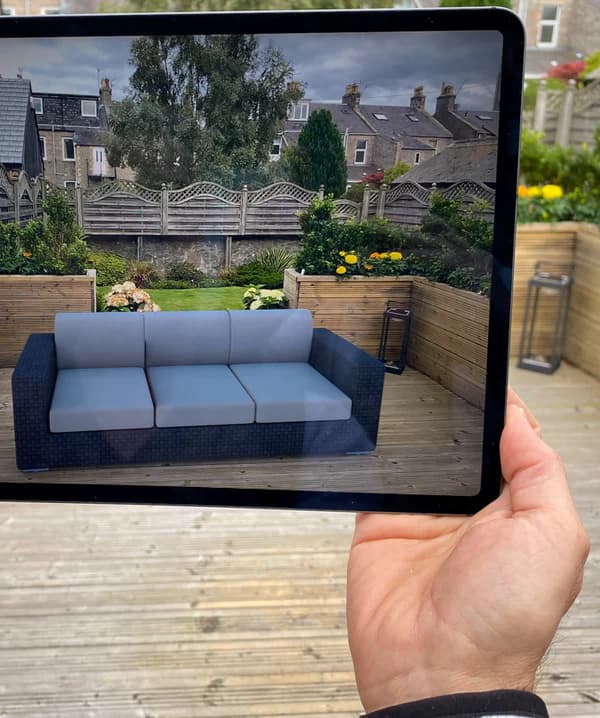
What makes a Snapchat lens shareable is the product appearing in the shopper's own picture, and a product page on your own site can do the same. A 3D model with a web AR button opens in the phone camera from an ordinary link, on iPhone and Android. The shopper places the sofa in the room and can screenshot it and send it on.
The AR view uses the same model the shopper saw in the 3D viewer, exported for the phone.
Where the button sits affects how often it's used. Put it where a phone shopper will see it, close to the price and outside any tab. The model has to be good enough to share as well, with the right fabric, proportions and scale.
Measuring it
Track views of the 3D viewer, taps on the AR button, and the conversion and return rates on products that have them against products that don't. For sharing, watch your analytics for visits to product page URLs and searches for your product names coming from messaging apps and Instagram stories.
The order we recommend
A filter sends people to a product page, so the page should show a 3D model before any filter is commissioned. We put the AR in the browser and leave it on the product page for as long as the product is sold, where a sponsored lens runs for the length of the campaign.
Sources
- Deloitte Digital and Snap Inc., consumer AR report press release, May 2021.
- WWD, Gucci reveals Snapchat AR shoe try-ons, July 2020.
- Pinterest Newsroom, Pinterest introduces AR Try On for Home Decor, January 2022 and TechCrunch, Pinterest's AR shopping feature expands to furniture.
- WebKit, Viewing augmented reality assets in Safari for iOS.