Furniture and home3 min read
Where 3D helps a furniture ecommerce shop differentiate
What 3D and AR change for a furniture retailer competing with a marketplace, and where price, delivery and returns still decide the sale.
By CharpstAR · 25 Sept 2023 · Updated 29 Sept 2026
Part of Augmented reality for furniture retail: the complete guide

A furniture shop with a few hundred to a few thousand products competes mostly with marketplaces. A marketplace carries a hundred thousand items, lists yours next to cheaper lookalikes and delivers in two days.
You can't match that range, and on an identical product you usually can't match the price. What a smaller shop can do is pick the buying decisions it serves better than a marketplace does and put its tools there.
Where a marketplace page is weak
A marketplace uses one page template for a phone case and a wardrobe, so it covers each product thinly. The shopper gets a dimension table and five photos taken in a studio. Nothing on the page puts the item in their room at true scale, and for anything large, fit is the question that holds them back.
When the same-looking sofa is listed at three prices, nothing on the marketplace page explains why yours costs more.
Configuration doesn't fit the template either. Modular sofas, made-to-order upholstery, fabric and leg combinations, and corner units that come left or right handed are either listed as a separate SKU per permutation or left off the marketplace.
Where 3D and AR help
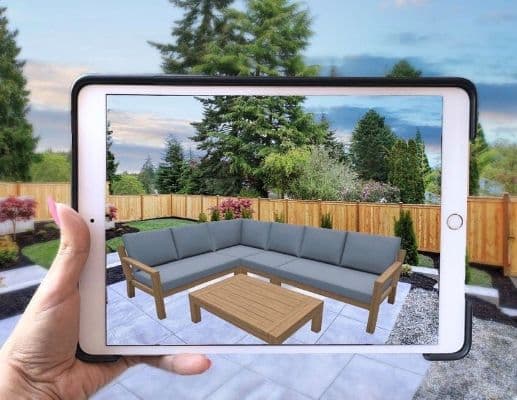
For furniture, fit is the most valuable question 3D answers. AR places a correctly scaled model in the room, and the shopper stands where the sofa will go and sees whether it fits the wall it's meant for.
A 3D model can carry annotations on the joint, the frame timber, the seat construction and the fabric rating, so the shopper can see what the extra 40 percent pays for. Photographs show the joint and the frame only from the angles the photographer chose; with a model the shopper turns the product over and looks where they want.
Configuration is where the gap is widest, because a marketplace's template has no room for it. A shopper builds a corner sofa in the right fabric with the chaise on the right side and then places it in their living room.

Example catalogue
Garden dining set
€2,864
01 TableWood top, 200 × 100 cm, €1,190
02 ChairsRope, €279 each
03 Seats6
A garden dining set. Choose the table, the chair and how many; the price and the floor area it needs update with each choice.
A model built once also serves the product page, the AR view, the configurator, catalogue renders, social and email, and takes that work off the photography budget.
Where 3D makes no difference
If the identical product is 30 percent cheaper elsewhere, a 3D model won't change that. Delivery date and cost often decide a furniture purchase. A shopper who needs a sofa before a move date takes the one that arrives first, so a stock line such as "Available in 8 to 12 weeks" belongs on the page, and slow, unclear or expensive delivery is the thing to fix before product imagery.
Shoppers weighing a first order from an unfamiliar site read the returns policy. A 3D model has no effect on that.
| Decision point | Does 3D help? | What decides it |
|---|---|---|
| Will it fit my room | Yes, strongly | AR at true scale, dimension lines |
| Is it well made | Yes | Annotated model, plus accurate specs |
| Can I get the version I want | Yes, via configurator | Configurator plus real lead times |
| Is it cheaper elsewhere | No | Price, bundles, service |
| When does it arrive | No | Delivery promise on the page |
| What if I hate it | No | Returns policy and its wording |
| Is this shop legitimate | Slightly | Reviews, contact details, payment options |
What to do first on a limited budget
With a limited budget, we'd spend it in this order.
- Delivery date, stock status and return terms visible on a phone without scrolling.
- Models for the top sellers; in furniture a small share of products usually brings most of the revenue, so start there and add the rest later.
- The categories where size decides the purchase: sofas, beds, wardrobes, dining tables, stoves, large rugs and lighting. Contura sells wood-burning stoves, where clearance decides the purchase. Small accessories can wait for a later round.
- A configurator, if you sell configurable products; a fixed-spec item gains little from one.
- Your own figures: rotation rate, AR open rate and conversion for sessions that used the model against sessions that didn't.