Furniture and home5 min read
3D prototyping in furniture product development
Using 3D models in furniture and hard goods development: fewer prototypes, clearer briefs for suppliers, and the reviews that still need a real sample.
By CharpstAR · 4 Oct 2023 · Updated 22 Sept 2026

In a normal furniture development process, a new dining chair gets built three or four times before anyone signs it off. There's the first factory sample, a revision after the design review, another once the buyer has seen it, and sometimes a fourth after a material change. Each round means a shipment, a few weeks of waiting and a discussion over workshop photos taken in bad light.
Many of those rounds happen because a drawing can't show people what they want to see, and the only other option is a real chair. A 3D model fills the gap between the two, and for hard goods it can take several rounds out.
CAD files, review models and samples
Furniture and hard goods teams usually have CAD already, drawn so the factory can make the piece.
| Asset | Built for | Answers |
|---|---|---|
| CAD / engineering model | Manufacturing. Exact geometry, tolerances, joinery | Can this be made, and how |
| Visual 3D model | Looking at. Real materials, correct proportions, light | Does this look right, does it suit the range, is the scale sensible |
| Physical sample | Touch, weight, comfort, durability | Does it feel right, does it survive use |
A lot of prototype rounds are spent answering a middle-row question with a bottom-row object. When a buyer says "the back is too heavy visually" or "that oak is too orange next to the existing range", they're commenting on how the chair looks, and a model at true scale is enough to check that.
Review rounds a model can replace
Proportion and silhouette
Seat height, back angle, leg taper and the way a table top sits on its base are easier to judge on a model at true scale, in a viewer or placed in a real room with AR. Photos of a sample on a factory floor are almost always taken at an awkward angle in poor light.
Materials and finishes
For furniture this is the biggest saving. A frame in four woods with six fabrics makes 24 combinations, and nobody is going to build all of them. As models they're one geometry and a material library, and the whole set can be reviewed in a morning.
Fit with the existing range
To see whether a new item sits well with the twelve products already in the collection, someone has to look at all thirteen together. If the existing range is modelled, a rendered scene can put the new piece among them before it has been sampled.
Briefing the supplier
Plenty of first samples go wrong because the factory pictured something different from the brand. A factory working from a spec sheet and a reference photo has to interpret them. Sending a 3D model with the spec sheet gives both sides the same picture of the finished piece, while the spec and the CAD still say how it gets made.
Furniture
Round two-seat sofa
Cream bouclé.

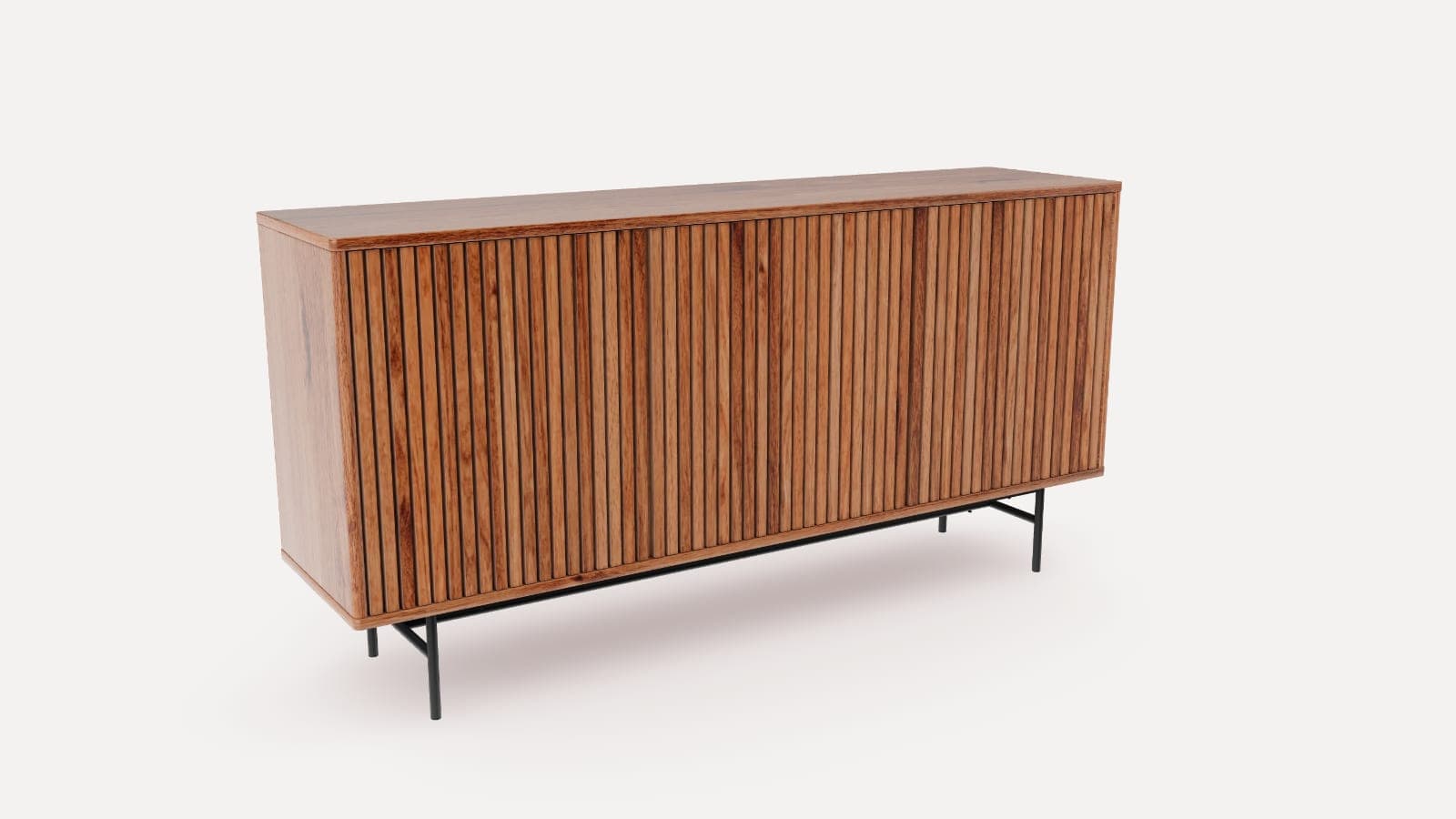
A round two-seat sofa as a review model: turn it, switch the dimensions on, and on a phone stand it in the room at true size.
What still needs a physical sample
Anything that isn't visual still needs the real thing: comfort, whether a joint loosens after a year, how the foam holds up under a heavy person, whether the coating chips and whether a customer can put the flat pack together with the supplied allen key. Weight, smell and the sound a drawer makes belong on that list too.
The team still builds samples, but by the time it does, look and proportion have been settled on screen, and the samples go to testing comfort, strength and assembly.
The review model as the product page model
This matters most for hard goods sold online. After some finishing work, the model built to review the chair is the one that goes on the product page, so part of the launch's image budget is spent before the product exists. Catalogue renders, lifestyle images, web AR placement on Android and iOS, and a configurator if the product has options can all come from that one file.
Sweef went this way: its 3D started as internal product work and later became the configurator customers use on the site. On a stove range we modelled it happened in the other order, with the configurator built first and the same files used afterwards for product pages, in-store sales and marketing images.
Running it without adding cost
A model added on top of every existing physical round is one more cost on the launch. Before the project starts, agree which review the model replaces, and don't order a sample for that round.
Build the model early, from the CAD if there is any, and give one person the job of getting the materials right. When the wood grain is made up and the fabric sheen guessed, the first real sample overrules the model, and on the next product the team goes back to waiting for samples. To check whether our models are detailed enough to review from, pick a chair or table you're developing now and send it to us with whatever pictures and measurements you have.
Keep the review model and the production asset in the same pipeline, so the work at the end is a finishing pass on the same file.
What it costs
We charge per product per month, because ranges change and the models have to change with them; the tiers are on the prices page. Set that against what one prototype round costs on one product: making the sample, shipping it, and the weeks the team spends waiting for it.