Fashion4 min read
What it will take for AR glasses to change shopping
Vision Pro, Galaxy XR and the Android XR glasses, with prices and dates, what they do for shopping today, what has to change first and what to prepare now.
By CharpstAR · 21 Mar 2023 · Updated 22 Sept 2026
Every few months someone asks us whether they should be building for headsets. Our answer is no, not as a separate project. The work you'd do anyway for your product pages carries over to headsets, so in that sense you're building for them already.
The devices on sale and what they cost
Apple Vision Pro went on sale in the United States on 2 February 2024, starting at 3,499 dollars for the 256GB model. Apple calls it spatial computing, and in use it replaces a screen more than it overlays the room.
Samsung's Galaxy XR is the first device running Android XR, Google's operating system for headsets and glasses. It launched at 1,799 dollars or 149 dollars a month. It runs mobile and tablet apps from Google Play alongside XR apps, with Chrome rebuilt so browser tabs can be arranged around you, and Gemini as an assistant that has some awareness of what you're looking at.
Google has also said it is working with Samsung and the eyewear brands Gentle Monster and Warby Parker on lightweight glasses, and XREAL's Project Aura is described as the first wired Android XR glasses, with a 70 degree field of view.
What a headset changes for shopping
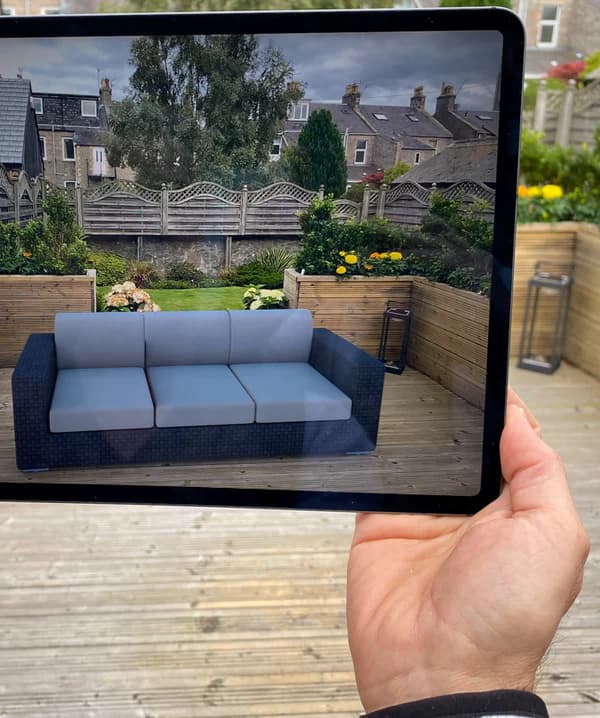
On a phone you hold the camera up with one hand, and the object disappears when you lower it. In a headset both hands are free and the virtual sofa stays in the room while you walk around it or check the sightline from the doorway. Scale is easier to judge with two eyes and a fixed object than on a phone screen.
Browsers are being adapted too. Chrome has been reworked for Android XR, and Apple has added an HTML `model` element to Safari on visionOS 26 that lets a page show a model inline and lets the user drag it out into the room. For a retailer this means the shopping experience can stay a web page, and nobody has to build and maintain a headset app.
What has to change before this is a channel
At 1,799 and 3,499 dollars these are devices for enthusiasts and professionals, so only a small share of any shop's customers owns one.
People put a headset on for a session, whereas most shopping happens in short bursts on a phone, on the sofa or on a train. Glasses could change that, which is why the glasses partnerships matter more for retail than the headsets do. The glasses that exist today aren't full augmented reality displays yet.
Content is the other gap. A headset shop with a handful of models feels empty; it needs most of the catalogue modelled before it feels like a shop, and few brands are there yet.
What is worth doing now
The aim is to be ready when the devices start to matter without spending anything extra on them now.
Store your models in GLB and USDZ, the formats Scene Viewer on Android and AR Quick Look on iPhone, iPad and Apple Vision Pro read already; a USDZ built for a phone today opens on a Vision Pro as it is. Shopify documents the same pair as its supported formats, with around 4 megabytes as a sensible target.
Meta showed the risk of putting the interaction anywhere but your own site when it shut the Meta Spark platform on 14 January 2025, and third-party AR effects on Instagram, Facebook and Messenger stopped working. Models hosted on a retailer's own site weren't affected.
Ask your provider to keep the source files. Headset rendering may eventually want more detail than a 4 megabyte web model holds. If the full-resolution source is kept, a higher-fidelity version later is an export job instead of a new model.
A separate headset experience can wait. The audience is too small to justify the upkeep, and if your product page already uses a standard 3D viewer, a spatial web page comes with it at no extra cost.
What we expect next
We expect the phone to stay the main device for AR shopping for years, and glasses to arrive first as a camera and an assistant before they become a shopping display. For retailers the bigger change is that shoppers will come to expect a 3D model on a product page the way they expect a size chart.
The formats, viewers and browser support are in place. What most brands lack is a modelled catalogue, and building one is several years of work.
Sources
- Apple, Vision Pro available in the US on February 2 and AR Quick Look.
- Google, introducing Galaxy XR, the first Android XR headset and Scene Viewer.
- Meta, a Meta Spark update.
- Shopify, 3D e-commerce.