Furniture and home6 min read
AR placement for garden products: what works outdoors
Planters, pergolas and hot tubs placed on a phone in the garden. Why tracking struggles on grass and in bright sun, and how to build models that cope.
By CharpstAR · 4 Oct 2023 · Updated 9 Oct 2026
Part of Augmented reality for furniture retail: the complete guide
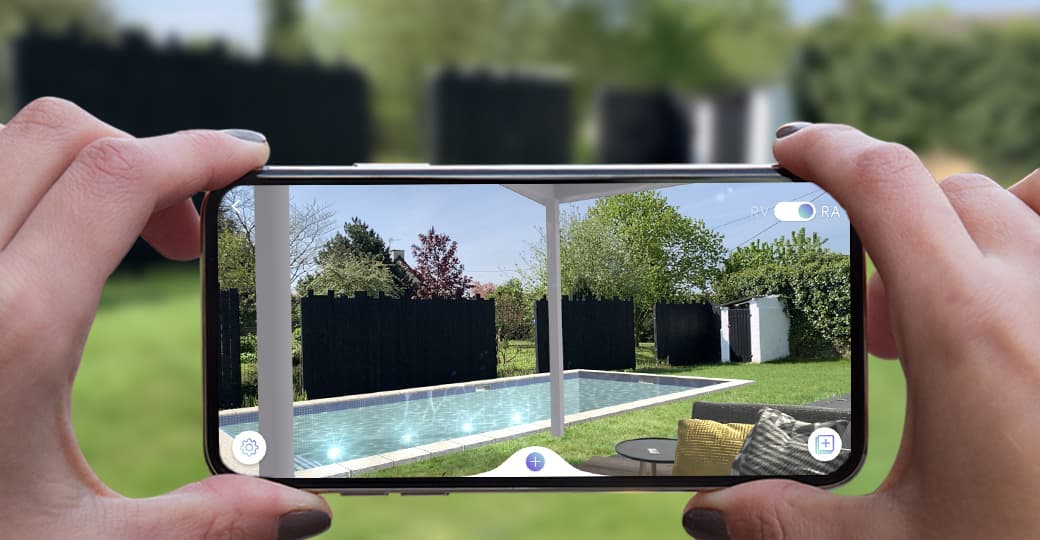
Garden products suit augmented reality because the customer is standing where the product will go, and the spot is usually empty. There is no sofa to move, no room to measure around. There is a patch of lawn, a corner of a terrace, a bare wall, and a question about size.
Outdoor products are also hard to judge from a photograph. A catalogue image of a pergola is shot in a garden nicer than yours, at a time of day that does not happen, with furniture under it that is not for sale. Putting the same pergola on your own patio at true size corrects for all of that.
The part that rarely gets written about is that phone AR works less reliably outdoors than indoors, for reasons you can plan around. This piece covers what placement tells the shopper, where the tracking struggles, and how to build models that cope.
What placement outdoors tells the shopper
Both mobile platforms will put a scaled 3D model into the camera view from a product page without an app. On Android it is Scene Viewer, where one unit in a glTF file is one metre, so the model appears at its real size. On iOS it is AR Quick Look in Safari.
For garden products that answers a few things the spec table cannot.
Whether it dominates the space. A 180 centimetre raised planter sounds moderate. In a small courtyard it is a wall. People underestimate the footprint of anything they have only seen photographed in a large garden.
Whether it clears things. A pergola or gazebo has to clear a door, a gutter, a washing line, a branch. Placed in AR against the actual back wall, that is settled in seconds.
Whether there is room for the thing plus the space around it. A hot tub needs access on more than one side for servicing, and a route to get it there in the first place. A shed needs a door swing. Placing the model makes the empty space around it visible, which the dimensions in a spec table never do.
That last one is the strongest case for garden AR and the one most product pages miss. If you can, model the clearance into the scene, with a faint outline around the hot tub for the service margin or the shed door drawn open.
Where outdoor tracking struggles
Phone AR builds a rough map of the surfaces in front of the camera and tracks the phone's movement against it. Gardens break several of the assumptions behind that.
Grass and gravel are poor surfaces. Plane detection needs texture with recognisable structure. A lawn is texture without structure, thousands of near-identical blades and no stable feature to lock onto. Models placed on grass take longer to anchor and are more likely to drift or sink when the shopper walks round. Gravel is better. Decking, paving slabs and patio tiles are better again, because the joints give the tracker something to hold.
Bright sun causes trouble twice. Blown-out highlights remove the features the tracker needs, and glare on the phone screen means the customer cannot see the result anyway. Overcast is the best weather for garden AR, which is not something you can put on a product page.
Large objects need distance. To see a whole pergola at true scale you have to stand far enough back to fit it in frame, often further than the garden allows, and tracking quality falls with distance. For anything over about three metres, expect the shopper to place it and walk round it rather than see it whole.
The lighting will not match. The model is rendered with its own lighting and outdoor light has an extreme range, so a model that looks right indoors will look slightly pasted on against a sunny lawn. This is a rendering limit rather than a fault in the model, and it matters less than you would think, because the shopper is checking size rather than colour.
Building garden models for those conditions
| Choice | What to do | Why |
|---|---|---|
| Scale | Model in real-world metres and check against the manufacturing drawing | Outdoor AR is a size question, so an error here undoes the exercise |
| Geometry | Keep the silhouette exact and simplify the detail | The outline is what the shopper reads at three metres; a screw head is invisible and costs load time |
| Ground contact | Give the model a flat, defined base | Legs on uneven ground look wrong and make people doubt the placement |
| File size | Optimise for mobile over cellular data | Garden AR happens in the garden, away from the wifi |
| Materials | Matte, realistic finishes rather than showroom shine | Glossy materials read as fake in daylight |
| Fallback | Offer rotation in a 3D viewer as well as AR | Rotation works on desktop, in bad weather and without a camera permission |
The last row is the one most projects get wrong. The 3D viewer on the page needs no camera permission and no trip outside, and it works on desktop. Build for the viewer first and let AR be the extra for the shopper who is on the patio with the phone.
What the numbers support
There is no reliable published data on AR for garden and landscaping products specifically. What exists is general. Shopify reported in 2020 that interactions with products carrying 3D or AR content converted 94 percent more often than the same kind of products without, and gave more detailed figures for Rebecca Minkoff and Gunner Kennels: 44 percent more likely to add to cart after a 3D interaction, 27 percent more likely to order, a 65 percent purchase lift on AR pages, and a 5 percent reduction in returns at Gunner Kennels.
Those are not garden numbers. They show that an accurate, scaled view of a product helps people buy it, which is the mechanism garden AR relies on. The reason the effort pays in this category is the returns side. The National Retail Federation put United States returns at 743 billion dollars in 2023, 14.5 percent of sales and 17.6 percent online, and a hot tub or a shed costs far more to collect than a parcel.
Neighbouring categories
The same pattern holds for anything with a size question in a fixed space. Contura customers configure a wood-burning stove online and see it in AR in the living room, where the clearance around it matters as much as the stove. Sweef put a modular sofa into a configurator with web AR, which is the pattern to copy if your garden furniture comes in sections.
Where to start
Pick the three products in your range that people most often get wrong on size. In most garden catalogues that is a large planter, a pergola or gazebo, and the biggest item you sell. Model those, put dimension lines on them, put the viewer on the page rather than in a separate tab, and keep the AR button visible but second.
We will model one of your products for free so you can put it live and see what your customers do with it. The model stays yours. Send us one product, and solutions and prices cover what comes after.
Sources
- Google, Scene Viewer documentation.
- Apple, AR Quick Look.
- Shopify, merchant data on 3D and AR content, September 2020.
- Shopify, AR shopping: Rebecca Minkoff and Gunner Kennels results.
- National Retail Federation and Appriss Retail, 2023 Consumer Returns in the Retail Industry.