3D for e-commerce7 min read
How a car configurator works, and what one costs to build
A 3D car configurator taken apart: the model, the paint, the wheels, the glass and the baked light, what each one weighs, and what a dealer or parts brand pays for one.
By CharpstAR · 25 Sept 2023 · Updated 7 Oct 2026
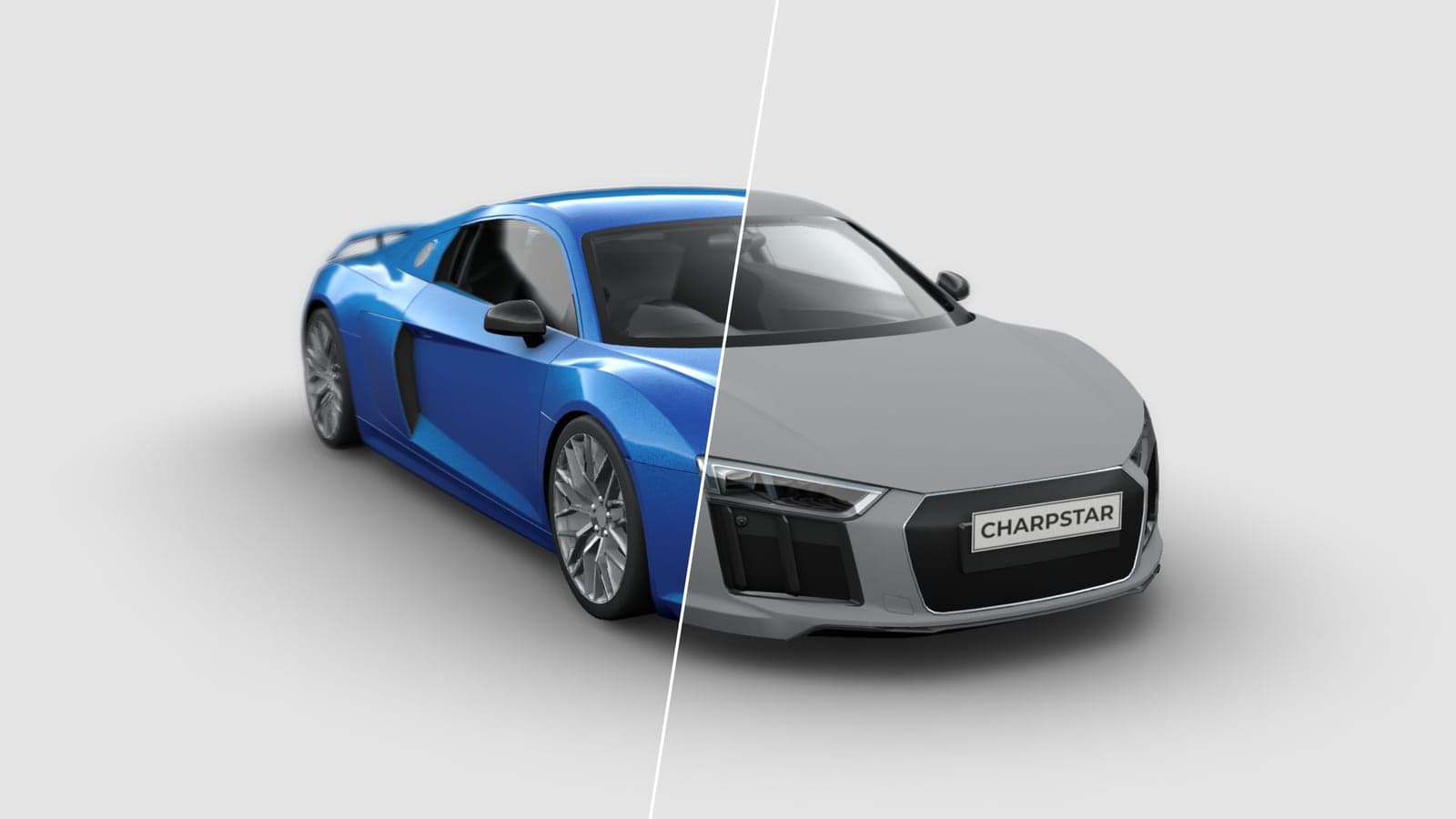
Our car configurator demo offers a sports coupé in eight paints, with three wheel finishes, three finishes for the side blades, six shades of glass and a number plate with your own text. The car's files come to about 3.5 megabytes on a computer and about 2.7 on a phone.
A 3D product configurator for a car is built from layers. The demo below is the same car with three switches. Each one turns off a layer the configurator puts together: the paint, the glass and the light. Turning them off one at a time shows what each layer does and why it is built the way it is.

The coupé from our car configurator. Switch the paint, the glass and the light off one at a time.
What the 3D model holds
The car is one GLB file of 1.3 megabytes. It holds 62,828 triangles in 26 parts, one part for each material: the body that takes the paint, the rims, the tyres, the glass, the chrome, the lamps and so on. There are no images inside it.
We started from a stock model with about 160 parts. Merging them into one part per material lets the browser draw the car in about 70 steps a frame where it took about 330. Most of the badges were separate parts in that model, so removing them meant deleting them. The letters on the fuel cap had to be cut out of it.
The interior is in the file, but the configurator no longer offers a view from inside. The stock model's cabin did not look good enough close up, so we took the interior view out of the demo and kept the outside.
Paint is a material
Switch the paint off and the body turns grey. That grey body is all the file contains. The colour is added in the browser.
Each of the eight paints is described by three colours: the colour where the light falls, the colour in shade and the colour of the metallic flake. The configurator draws the paint in three layers from those colours: the colour coat, the flake, and the clear coat that reflects the studio. A solid paint has no flake, and the pearl white has less of it than the metallics.
Nothing is downloaded when the shopper picks a paint, because a paint is a short list of numbers. For a dealer, adding a colour means adding one line with the paint's name, its code and its three colours.
Wheels are separate parts
The rims and tyres are parts of their own, separate from the brakes behind them. Together they are 25,516 triangles, about two fifths of the whole car. Round shapes and thin spokes need many triangles to look smooth.
The car configurator offers one wheel design in three finishes: silver, dark grey and polished. A finish is a material, like the paint, so it costs nothing to switch. A second wheel design would be a second part in its own file, and the configurator would swap one part for the other on all four corners.
This is the part of a car configurator that matters most to a wheel brand or an aftermarket shop. Every design in the catalogue becomes one 3D model, which can then be shown on each car the shop sells it for.
Glass is drawn in two layers
Switch the glass off and the cabin opens up. With the glass on, the configurator draws each window twice. The first layer darkens what is behind the window by the colour of the tint. The second layer adds the reflection of the studio on top.
Splitting it this way means the tint and the reflection can change separately. A darker tint makes the cabin harder to see and leaves the reflections as strong as they were, which is how tinted glass looks on a real car. The six shades from clear to limo black are six pairs of colours.
The light is computed once and stored in images
Switch the light off and the shadow on the floor goes, and the car seems to float. The wheels turn bright and flat, and the dark edges where one part meets another are gone.
That light was computed once, before the car went on the site, with a renderer that traces how light bounces around the car. This is called baking. The result is stored in three images: one for the painted panels, one for the other outside parts and one for the wheels, tyres and cabin. Each image holds three numbers per point: the light that comes straight from the studio, the light that arrives after a bounce, and how enclosed the point is. The shadow on the floor is a fourth image of 86 kilobytes.
The light was computed on a car painted plain grey, and the images hold the amount of light and no colour. So the shopper can change the paint without the light being computed again. This is also where most of the download goes. The image for the painted panels is 4,096 pixels across on a computer, so a contact shadow stays sharp up close, and 2,048 on a phone. That one change is the difference between the 3.5 and the 2.7 megabytes.
What a car maker builds and what a dealer needs
A car maker's configurator covers every model line, the whole cabin, hundreds of options and the rules about which of them go together. A dealer, a wheel brand or a shop selling roof boxes and tow bars needs far less than that.
| Part of the build | Car maker | Dealer or parts brand |
|---|---|---|
| Models | Every model line | One or a few cars, or the parts themselves |
| Options | Hundreds, with rules about combinations | Paint, wheels, one or two accessories |
| Interior | The full cabin | Left out, or photos |
| Price | Live, per market | Per option, or none |
| What the shopper takes away | An order to the factory | A saved link or an enquiry |
The last row is often the cheapest to build. Our demo saves a configuration as a link: press Save configuration and the address holds the paint, the wheels, the blades, the glass and the plate. A shopper can send that link to the dealer, and the dealer opens the same car.
What a car configurator costs
Three things set the price: the 3D model, the number of options, and the rules between them.
The model is usually the largest cost. A model from the manufacturer's design files or a good stock model can be prepared for the web. A car that has to be modelled from photos takes much longer. Every option that is a material, such as a paint, a wheel finish or a glass tint, costs very little once the model is ready. Every option that is a part, such as a wheel design or a body kit, is a model of its own.
Our demo was built in two days from a downloaded stock model. Most of that time went into the paint and the light.
Configurators are on our Value plan, from 20 dollars per model per month, for at least 100 models over 24 months. That includes the 3D model, hosting, updates, implementation, and a configurator for colours and textures. A car with parts that swap, like wheel designs or accessories, is quoted on its own. The plans are on the prices page.
The other configurators we have built are on the demo page, including the full car configurator. If you have a car or a part of your own in mind, send it to us. We answer within a working day with what it takes, and a product with colour and material options we configure free.
Questions
How does a car configurator work?
It shows a 3D model of the car in the browser and changes it as the shopper chooses. A paint or a finish changes a material on the model. A wheel design or an accessory swaps one part for another. The light and shadows are usually computed beforehand and stored in images that come with the model.
How large is a 3D car model for a website?
The coupé on this page is 1.3 megabytes for the model and about 2.1 megabytes for its light on a computer, about 3.5 megabytes in all. On a phone it is about 2.7 megabytes, because the largest light image is sent at half the size.
Does changing the paint colour download a new file?
No. A paint is a material described by a few colours, and the configurator redraws the car with it. A new wheel design or accessory is a new part and is downloaded the first time it is chosen.
How much does a car configurator cost?
It depends on the model, the number of options and the rules between them. Our configurators are on the Value plan, from 20 dollars per model per month, for at least 100 models over 24 months. Cars with parts that swap are quoted on their own.
Can a dealer or a parts brand use a car configurator?
Yes. A dealer usually needs one or a few cars with their paints and wheels, and a saved link or an enquiry at the end. A parts brand needs a model of each part, shown on one or more cars.
Sources
- The file sizes, triangle counts and part counts are from our own build of the car configurator shown above.
- The plan prices are from our prices page on 7 October 2026.