3D for e-commerce6 min read
Questions to ask a 3D and AR vendor before you sign
The questions that separate a serious 3D vendor from a good slide deck, including the ones about ownership, file sizes and revisions we would rather avoid.
By CharpstAR · 4 Oct 2023 · Updated 22 Sept 2026
Part of 3D models for e-commerce: the complete guide

We are a 3D and AR vendor. This is a list of the questions we would ask if we were buying instead of selling, including several that are uncomfortable for us to answer.
Print it, take it to three vendors, compare the answers side by side. The differences will be more informative than any of the pitch decks.
Before the call: know your own numbers
Two things to have ready, because a vendor who asks for them is already better than one who does not.
Your distinct geometry count, not your SKU count. A sofa in twelve fabrics and three sizes is 36 SKUs but usually one to three models plus material variants. Getting this wrong inflates every quote by an order of magnitude.
Your reference material situation. Do you have CAD? Photographs of the back and underside? Reliable dimensions? Products with CAD are faster and cheaper. A vendor who quotes without asking has not priced your actual job.
The proof questions
1. Can I open a live model of a product like mine, on my phone, right now?
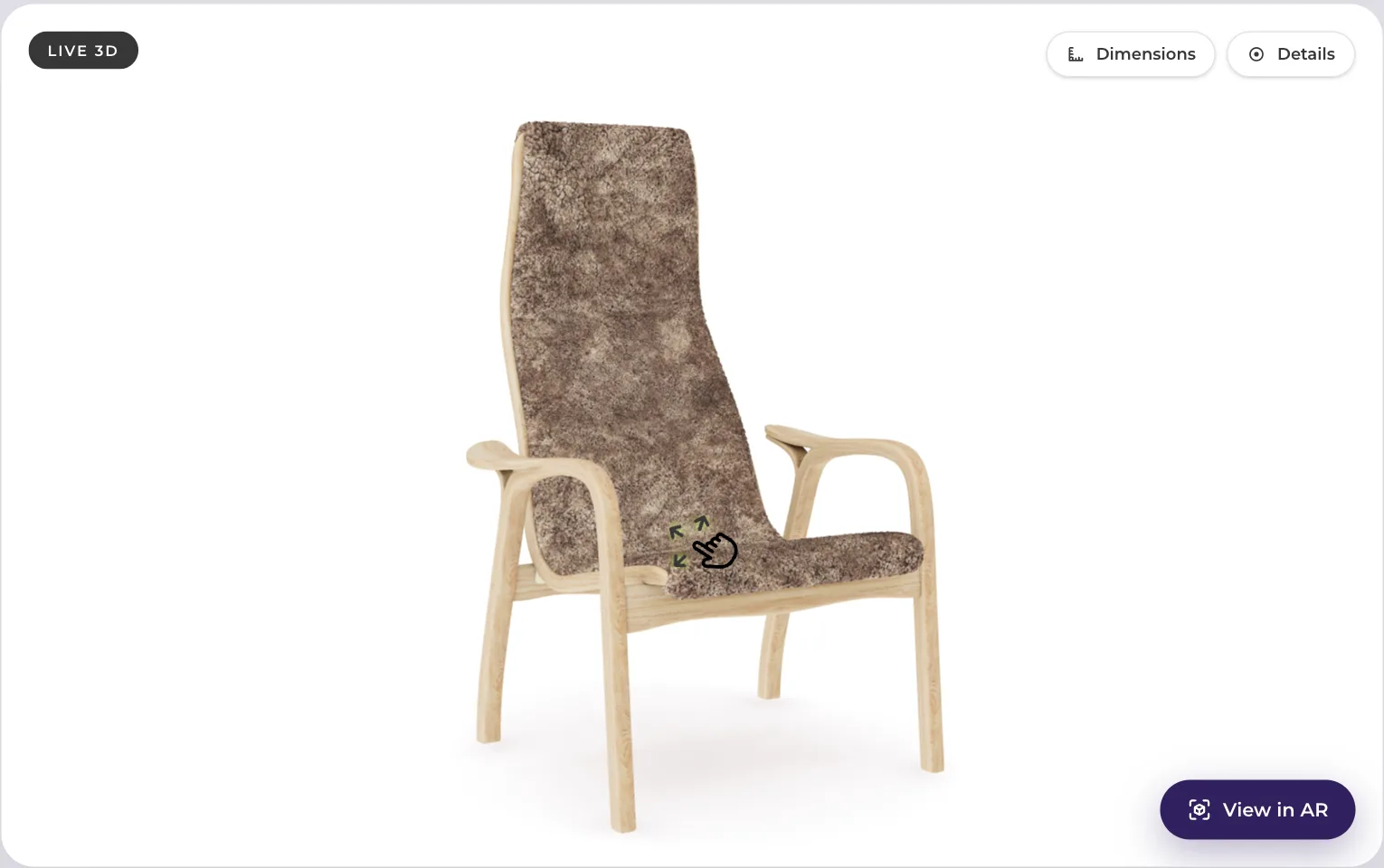
Not a video. Not a render. A URL. If they cannot produce a working link in your category within the call, you are their pilot in that category, and you should be paid for that rather than paying for it.
2. Which live retail sites are running your models today?
Ask for the site, not the logo. Then open the product page on your phone and tap the AR button. You will learn more in thirty seconds than from an hour of slides.
3. Show me a model of a hard product. Upholstery with visible stitching, woven fabric, brushed metal, glass, a wood grain that runs correctly across a joint. Every demo reel has a clean white lamp in it. The hard materials are where quality actually varies.
The technical questions
4. What file sizes do you deliver, and in which formats?
The answer should include GLB for web and Android and USDZ for iOS, and it should include numbers. Google's Scene Viewer documentation recommends models under 10 MB with a hard limit of 15 MB, textures at 2048 by 2048 or below, 100,000 triangles as the maximum and 30,000 to 50,000 as the ideal, and around ten materials. Shopify puts the ideal GLB for a product page at about 4 MB.
A vendor who does not know these constraints has been delivering to marketing renders, not to product pages. Their models will be beautiful and they will not load.
5. Who does the format conversion, and who does it again when the formats change?
GLB and USDZ both evolve. Someone has to re-export. If the answer is "you do", price that.
6. Where are the models hosted and what is the delivery latency in my markets?
A model served slowly from the wrong continent is one nobody sees.
7. How do you handle variants?
The right answer is a material swap on a shared geometry, not a separate model per colour. If they quote you per colourway at full model price, walk.
8. What accuracy do you guarantee on dimensions, and what do you do if my product data is wrong?
AR at real size makes your data errors physical. A good vendor will flag inconsistencies rather than quietly modelling the wrong number.
The commercial questions
9. Do I own the models? What happens to my files if I leave?
Get this in the contract. Both business models are legitimate, subscription-with-hosting and one-off-with-ownership, but you need to know which you bought. Ours is subscription: Basic from $10 per product per month on 12 months with a minimum of 100 variants, Value from $20 per model per month on 24 months, Enterprise quoted. Ask us the same question and hold us to the answer.
10. How many revision rounds are included, and what counts as a revision?
"The oak is too orange" and "actually make it a different chair" are both called feedback and only one is a revision. Get the definition written down.
11. What is the price for a product I add in month seven?
Catalogues grow. A price that exists only for the initial batch is not a price.
12. What is the minimum commitment and the exit?
Including ours. A 24-month term is a real commitment and you should know what you are getting for the length of it.
13. What do you need from me, as a list?
A vendor who cannot immediately enumerate the reference material, approvals and access they need has not thought about your side of the work, which is where most projects actually run late.
The questions vendors would rather you did not ask
14. What can your models not do?
Any honest answer is a good sign. Real limits exist: fabric drape on garments is approximate, very complex mechanisms are expensive, glass and liquid are hard, extremely large scenes hit file size ceilings. A vendor with no limitations to offer is selling.
15. How much of this is automated, and what does the automation get wrong?
Photogrammetry and AI-assisted modelling are real and useful, and they also produce specific characteristic failures: soft edges, baked-in lighting, wrong scale, messy topology. Ask which parts of your job would be automated and ask to see an unedited output.
16. Who actually does the modelling, and where?
Not a gotcha, a capacity question. If it is a partner studio, ask what happens when that studio is busy.
17. Can you show me a project that went badly and what you changed?
The answer tells you whether the company has shipped enough to have failures.
18. What conversion improvement should I expect?
The correct answer is "we do not know for your catalogue". Anyone quoting a specific percentage as a forecast is misusing published data. The real figures are worth citing with caveats: Shopify reported in 2020 that interactions with products carrying 3D or AR content converted 94 percent more often than the same kind of products without, and published Rebecca Minkoff results showing shoppers 44 percent more likely to add to cart after a 3D interaction and a 65 percent purchase lift on AR-enabled pages. All of those are merchants who chose their best products to model. They justify a pilot. They do not forecast your result.
19. Will this reduce my returns, and by how much?
Be suspicious of a big number. The National Retail Federation and Appriss Retail put United States returns at 743 billion dollars in 2023, 14.5 percent of sales and 17.6 percent online. AR reduces the slice caused by an item not fitting the space. It does nothing for colour disappointment, quality complaints or late delivery. A vendor who claims a percentage against your total return rate has not thought about reason codes.
How to compare the answers
Score each vendor on three things: did they produce a live model in your category, did they know the file size constraints without looking them up, and did they name a limitation without being pushed. Three out of three is worth a pilot even at a higher price. Zero is a slide deck.
Then run a pilot on ten to twenty products before signing anything long term, with the viewer live on real product pages and analytics tracking rotations, AR opens and conversion for sessions that interacted.
Our clients ran that sequence. Sweef started with a handful of sofas before the full configurator. Contura started with the stoves generating the most clearance questions. MELIMELI started with products they were about to reshoot anyway.
If you want to run the pilot before choosing anyone, use us as the free data point. We will build a 3D model of one of your products at no cost so you can judge the quality yourself. Send us one product and the model is yours to keep, whichever vendor you sign. What we build beyond that is on solutions and prices.
Sources
- Google, Scene Viewer documentation.
- Apple, AR Quick Look.
- Shopify, 3D e-commerce.
- Shopify, merchant data on 3D and AR content, September 2020.
- Shopify, AR shopping.
- National Retail Federation and Appriss Retail, 2023 Consumer Returns in the Retail Industry.