Furniture and home6 min read
Grills, saunas, sheds and play equipment: visualising the big outdoor stuff
Outdoor products beyond furniture are bought on scale and placement. What a 3D model and AR settle for each category, and what they cannot.
By CharpstAR · 25 Sept 2023 · Updated 22 Sept 2026
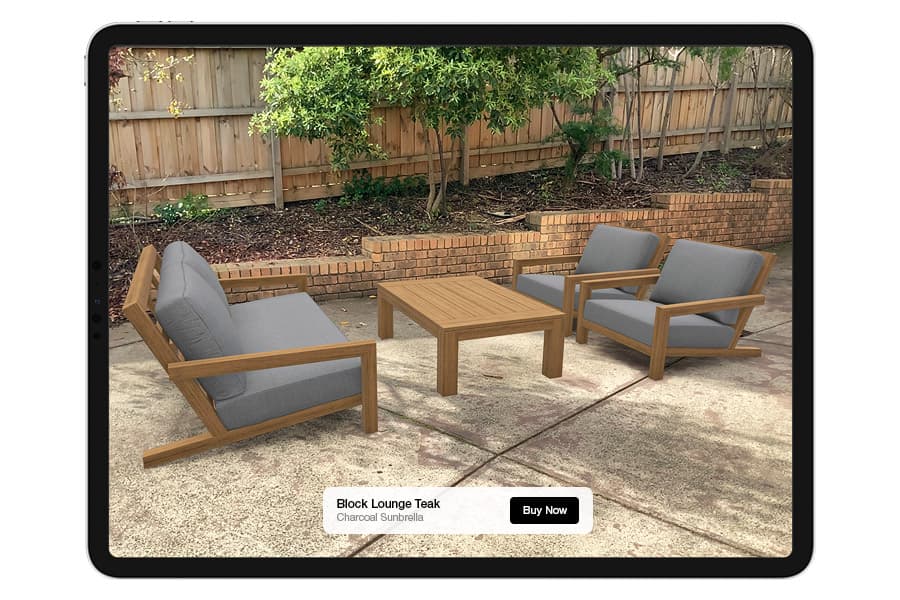
Outdoor furniture gets all the attention in this conversation, and it is the easy case. The harder and more interesting categories are the big permanent things people put in gardens: grills and outdoor kitchens, saunas and hot tubs, sheds and garden rooms, trampolines and play equipment.
These share three traits that make them awkward to sell online and well suited to 3D. They are large enough that the garden has to be planned around them. They are expensive enough that people hesitate for weeks. And they are almost impossible to judge from a catalogue photograph, because every catalogue photograph of a garden building is taken in a garden three times the size of the customer's.
Scale is the decision, and photos actively mislead
Start with an honest observation about product photography in this category. An outdoor kitchen shot on a large terrace looks like a compact unit. A shed photographed against an open field looks modest. A six-person hot tub shot from above looks smaller than it is. None of that is dishonest on purpose. It is what happens when you photograph something large in the setting that flatters it. The result is a shopper whose mental image is systematically smaller than reality, corrected on delivery day.
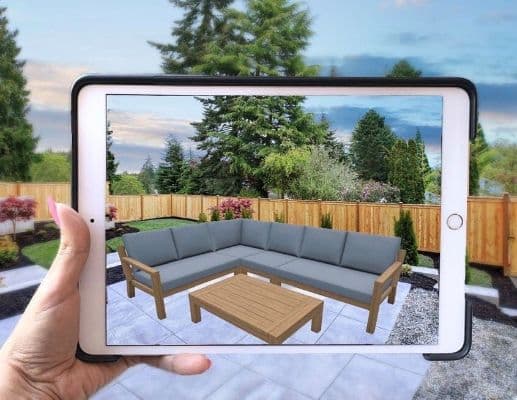
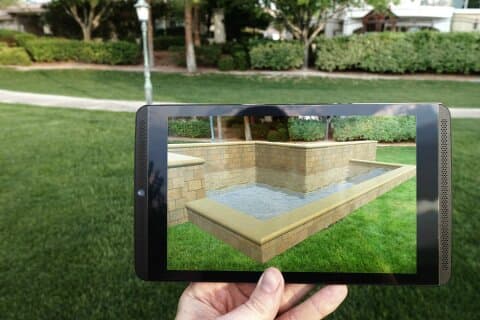
A 3D model with dimension lines corrects part of it. AR at true scale corrects the rest, and it works from the browser with no app on either platform: Scene Viewer on Android, where one unit in the glTF file equals one metre specifically so models appear at real size, and AR Quick Look in Safari on iOS.
Category by category
Grills and outdoor kitchens. The questions are footprint, working height, and clearance from the house wall and from anything flammable. Modular outdoor kitchens add a configuration question on top, because the customer is assembling a run of units and needs to know the total length before they know whether it fits the terrace. This is a configurator problem more than an AR problem, though both help. Include the lid in the open position in the model: lid clearance under a pergola or an awning is the detail that catches people out.
Saunas and hot tubs. Footprint plus service access plus the route to get it there. A hot tub needs clear space on more than one side for servicing, and it has to be craned or wheeled into position past gates, side passages and steps. AR placement helps with the first two. The delivery route is a question to answer in copy with a clear minimum access width, because nobody is going to AR their side passage.
Sheds and garden rooms. Footprint, ridge height, door swing, and whether it clears the boundary rules. Ridge height is the underrated one, because it is what determines whether the building looms over a small garden. Show the model from the side at eye level, not just the three-quarter view, and if you can, model the door in its open position.
Trampolines and play equipment. Diameter, safety margin around the unit, and height under any overhanging branch or wire. This category has a real safety dimension to the size question, so the clearance zone deserves to be part of the model rather than a line in a manual.
| Category | Decisive question | Best tool |
|---|---|---|
| Grills and outdoor kitchens | Run length, working height, lid clearance | Configurator plus dimension lines |
| Saunas and hot tubs | Footprint, service access, delivery route | AR placement plus explicit access copy |
| Sheds and garden rooms | Footprint, ridge height, door swing | AR placement, side elevation in the viewer |
| Trampolines and play equipment | Diameter plus safety margin, overhead clearance | Model the clearance zone, not just the object |
The common thread is that the useful thing to visualise is often not the product. It is the space the product demands. Very few product pages in this category show the clearance zone, and it is the cheapest improvement available.
Where outdoor AR gets flaky
Worth setting expectations before you build, because the failures are predictable.
Plane detection needs surface texture with structure. A uniform lawn has texture without structure and tracks poorly, so models placed on grass can drift or sink when the shopper walks around. Paving, decking and gravel work much better because the joints and edges give the tracker something to hold.
Bright sun is a double problem: blown highlights destroy the features the tracker uses, and screen glare means the shopper cannot see the result anyway. Overcast is the best weather for this, which is an awkward thing to put on a product page.
Large objects need distance. To see a three metre garden room whole you have to stand far enough back to frame it, which many gardens do not allow, and tracking degrades with distance. Expect people to place it and then walk around it.
And lighting will not match perfectly. A rendered model against real daylight looks slightly pasted on. That matters less than you would expect, because the shopper is checking size, not colour.
Build for the viewer first, the AR button second
The most common planning error here is treating the whole thing as an AR project. On the pages we work on, rotation in the 3D viewer is the majority interaction and AR placement is a minority one. Rotation costs the shopper nothing, and it works on desktop, where much of the research for a garden room happens.
So put the viewer on the page rather than behind a tab, put dimension lines on the model, and keep the AR button visible but secondary. Then optimise the file hard, because the person checking in the garden is on cellular data. Shopify's 3D commerce guidance puts the ideal GLB at around four megabytes, with anything over fifteen optimised automatically.
The numbers worth quoting, and the ones to avoid
There is no published, category-specific data on 3D and AR for saunas or sheds, and any percentage you see attached to those categories in a sales deck was made up. The general figures are real. Shopify reported in 2020 that interactions with products carrying 3D or AR content converted 94 percent more often than the same kind of products without, which is a merchant-data comparison rather than a controlled test. Their Rebecca Minkoff and Gunner Kennels results give 44 percent more likely to add to cart after a 3D interaction, 27 percent more likely to place an order, 65 percent purchase lift on AR pages, and a 5 percent return-rate reduction.
The returns argument is what makes this pay in big outdoor goods. The National Retail Federation put United States returns at 743 billion dollars in 2023, 14.5 percent of sales and 17.6 percent for online purchases. A returned hot tub or garden building costs a multiple of a returned chair, and a meaningful share of those returns are pure size and expectation mismatch, which is exactly the slice an accurate scaled model removes.
Adjacent evidence from our own clients
The closest parallel we have built is stoves. Contura customers place a wood-burning stove in the living room at true size before ordering, and the valuable part turned out to be the clearance around it as much as the object itself, which is the same lesson as the hot tub service margin. Sweef runs a configurator on modular pieces, which is the pattern to copy for modular outdoor kitchens. MELIMELI reuses one model set across the shop and campaign material, which is where the cost case for 3D over a shoot stops being theoretical.
Pick the item people most often get wrong
In most outdoor catalogues that is the biggest thing you sell. Model it, put dimension lines on it, show the clearance zone, and watch what your own traffic does. We will build a 3D model of one of your products for free so you can run that test, and it is yours to keep. Send us one product. See solutions and prices for what comes next.
Sources
- Google, Scene Viewer documentation.
- Apple, AR Quick Look.
- Shopify, 3D e-commerce guide.
- Shopify, merchant data on 3D and AR content, September 2020.
- Shopify, AR shopping: Rebecca Minkoff and Gunner Kennels results.
- National Retail Federation and Appriss Retail, 2023 Consumer Returns in the Retail Industry.