3D for e-commerce5 min read
Agency, in-house team or subscription: the three ways to get 3D models
What an agency project, an in-house 3D team and a subscription service actually cost and trade off, and which one fits which kind of catalogue.
By CharpstAR · 22 Sept 2026

There are three ways to get 3D models of your products, and the choice is less about price per model than about what happens in month seven. We sell one of the three, so read the trade-offs with that in mind. We have tried to make the case for the other two properly rather than setting up a straw man.
Option one: an agency project
You brief a studio, they quote per model or per batch, they deliver files, you pay and the project closes.
What is genuinely good about it. You get exactly what you commission, with no commitment beyond the invoice. For a launch, a campaign, or a single hero product that needs to look extraordinary, this is often the right answer and the highest ceiling on quality. Good studios employ people who will spend three days on the stitching of one cushion, and if that matters to you, buy it.
Where it hurts. Revisions are a negotiation. Your catalogue does not stand still, so every new fabric, finish or product means a new scope and a new purchase order, and at some point the procurement overhead exceeds the modelling cost. Six months later you need a small change to a file and the person who built it has moved on. And because the cost is capital rather than operating, it competes with things like a new warehouse racking system in the budget round, which it will lose.
Best fit. Fewer than about thirty products, a stable catalogue, or a one-off campaign.
Option two: an in-house 3D team
You hire one or more 3D artists, buy the software, and build a pipeline.
What is genuinely good about it. Control and speed on iteration. A product manager can walk over and ask for a change. Institutional knowledge accumulates: your artist learns your materials, your lighting, your quirks, and after a year the models get faster and more consistent. If 3D is central to your product development, not just your marketing, this pays.
Where it hurts. It is a hiring problem before it is a 3D problem. One artist is a single point of failure who takes holidays and eventually leaves with the pipeline in their head. Two artists is a real salary line. On top of that comes software, hardware capable of rendering, and the management time to keep a small specialist function busy. Utilisation is the killer: catalogue work arrives in bursts around product launches, and an artist who is fully loaded in March is underused in July.
There is also a quiet scope problem. Once you have a 3D artist, everyone in the building has a request, and product page models end up behind the trade fair animation.
Best fit. Large catalogues, continuous new product development, or a business where 3D feeds design and manufacturing as well as marketing.
Option three: a subscription service
You pay a monthly fee per product or per model and the provider builds, maintains, hosts and updates the assets.
What is genuinely good about it. The cost is operating expenditure, so it is approved differently and at a lower level. Maintenance is included, which matters more than people expect: platform requirements change, formats get tightened, a fabric supplier changes a weave, and someone has to keep the files current. Capacity flexes with your launch calendar rather than with your headcount.
Where it hurts, honestly. You are committing to a term. Our own Basic plan starts at 10 dollars per product per month on a 12-month term with a minimum of 100 variants, and Value starts at 20 dollars per model per month on a 24-month term, with Enterprise quoted. Over a long enough horizon, a subscription costs more than a one-off purchase of the same models would have. You are paying for maintenance, hosting and the option to change your mind, and if your catalogue genuinely never changes, that is money you did not need to spend.
You are also dependent on a provider. Ask for the source files and the delivery formats in writing before you sign, so that leaving is possible.
Best fit. A hundred products or more, ongoing variant churn, and no appetite to run a specialist function in house.
The comparison, with the things nobody puts in the table
| Agency project | In-house team | Subscription | |
|---|---|---|---|
| Cost shape | Capital, per project | Salaries plus tools, fixed | Operating, per product per month |
| Approval path | Business case | Headcount approval | Departmental budget |
| Speed for the first ten models | Fast | Slow, hiring first | Fast |
| Cost of a small change in month seven | New scope | Same day | Included |
| Format and platform maintenance | Yours | Yours | Provider's |
| Capacity when launches cluster | Buy more | Bottleneck | Flexes |
| Capacity when nothing launches | Pay nothing | Paying anyway | Paying anyway |
| Quality ceiling | Highest | High and rising | High and consistent |
| Risk | Scope creep | Key-person dependency | Provider dependency |
The maintenance point, since it is the one people underestimate
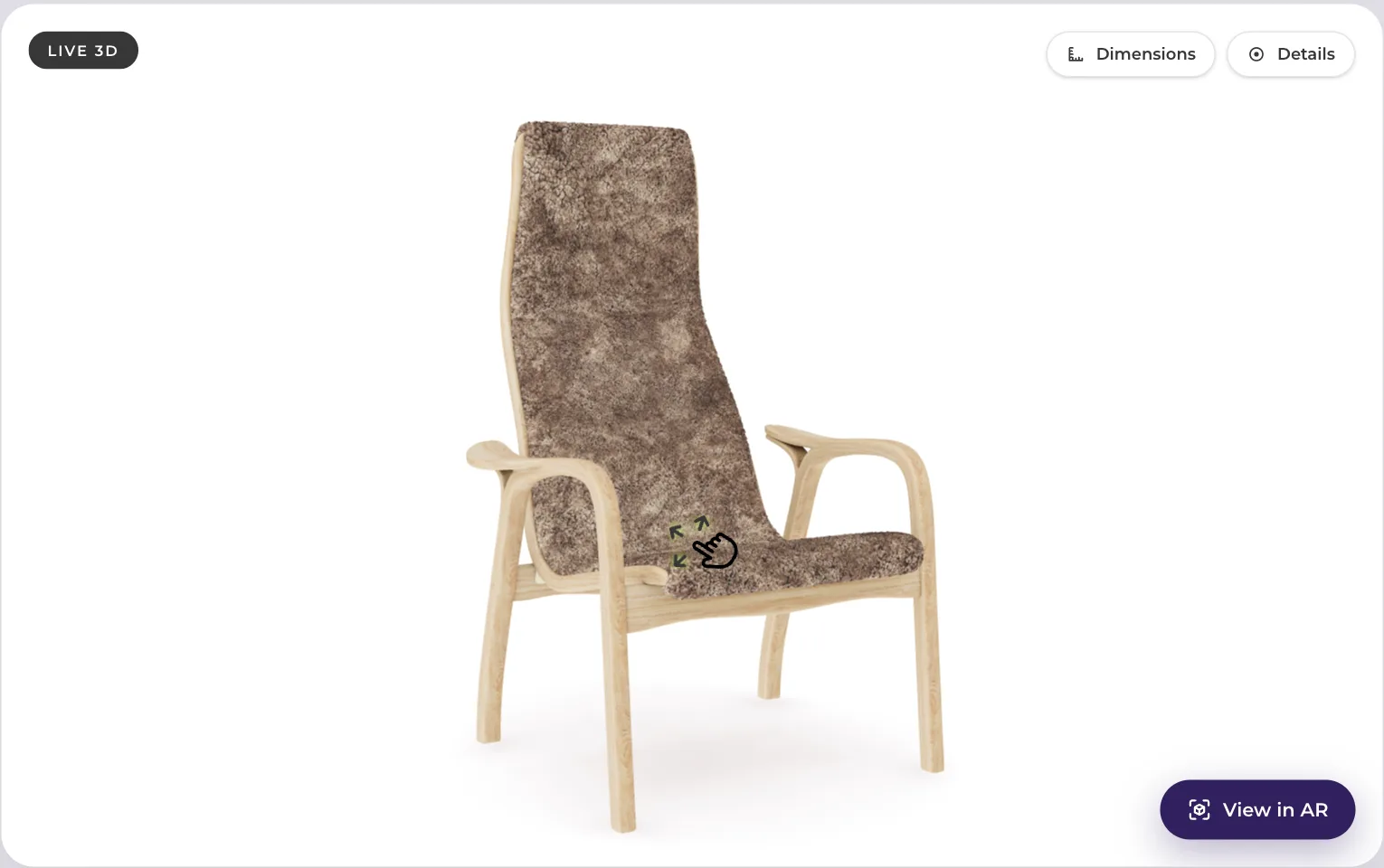
Product models are not finished objects. The platforms move. Shopify documents GLB and USDZ as the supported formats, automatic optimisation above 15 megabytes and roughly 4 megabytes as a sensible target. Google's Scene Viewer asks for glTF 2.0 or GLB with a practical ceiling of 100,000 triangles and 10 materials. Apple's AR Quick Look wants USDZ, and has added material variants and an HTML `model` element in Safari on visionOS 26.
Every one of those is a thing somebody must track. With an agency you will pay for the update. In house it lands on your artist. On a subscription it is the provider's problem, which is a large part of what the monthly fee buys.
How to actually decide
Count your products, count your variants, and ask how many of them will change in the next two years. If the answer is "very few and the catalogue is small", commission an agency. If the answer is "constantly, and 3D also feeds our product development", hire. If the answer is "a lot of products, a lot of variants, and we are a commerce team not a studio", subscribe.
That is the same logic our clients applied. Sweef had internal 3D resources already and needed them turned into something customer-facing. Contura had CAD files from manufacturing and a range with many models and options. MELIMELI had an online-first sales model and an expensive content production problem.
Before committing to any of the three, get one model made and see what the deliverable actually looks like in your own page. Send us one product and we will build it for free, yours to keep either way. Everything we build is described on solutions.
Sources
- Shopify, 3D e-commerce.
- Google, Scene Viewer documentation.
- Apple, AR Quick Look.