3D for e-commerce6 min read
3D renders or a photo shoot? When each one is actually cheaper
An honest cost comparison between product photography and 3D renders, including where a shoot still wins, the hidden costs on both sides, and our own pricing.
By CharpstAR · 25 Sept 2023 · Updated 22 Sept 2026
Part of 3D models for e-commerce: the complete guide

The usual version of this article claims 3D is always cheaper than photography and prints an invented day rate to prove it. It is not always cheaper. For a single product you will photograph once and never change, a shoot is faster and costs less. The question worth answering is where the crossover sits, and that depends on three things: how many variants you have, how often the product changes, and how many different places the image has to appear.
Here is how to work out which side of the line you are on. The only concrete prices below are our own, because those are the only ones we can stand behind.
What you are actually comparing
A photo shoot buys you a set of finished images. A 3D model buys you the ability to produce images, indefinitely, plus a few things photography cannot do at all.
That difference is the whole comparison. A shoot is a one-off purchase of output. A model is a capital asset that produces output on request.
A shoot costs: studio or location time, a photographer, a stylist for anything lifestyle, retouching, and the logistics of getting physical product to the studio. That last item is invisible on the invoice and often the largest real cost, particularly for furniture, where samples are built, crated, shipped and then written off.
A model costs: the modelling itself, which is mostly materials work rather than shape work, plus hosting and delivery, plus a revision whenever the product genuinely changes.
Where a photo shoot wins
Be honest about this list.
One product, one set of images, no variants. If you need six photographs of one item and the item will not change, a shoot is the straightforward answer.
Human models. People are still cheaper and better photographed than rendered. Every argument for 3D weakens the moment a person needs to be in the frame.
Complex lifestyle scenes. A cluttered, lived-in kitchen with real light and real mess is a discipline of its own. Rendering one convincingly costs more than shooting one.
Texture-led products with irregular character. Anything where the appeal is in the natural variation, like a hand-thrown ceramic or heavily figured stone, needs a very good model to beat a photograph.
You need it this week. A first model from a complete brief takes roughly a working week. A photographer can shoot tomorrow.
Where a 3D model wins
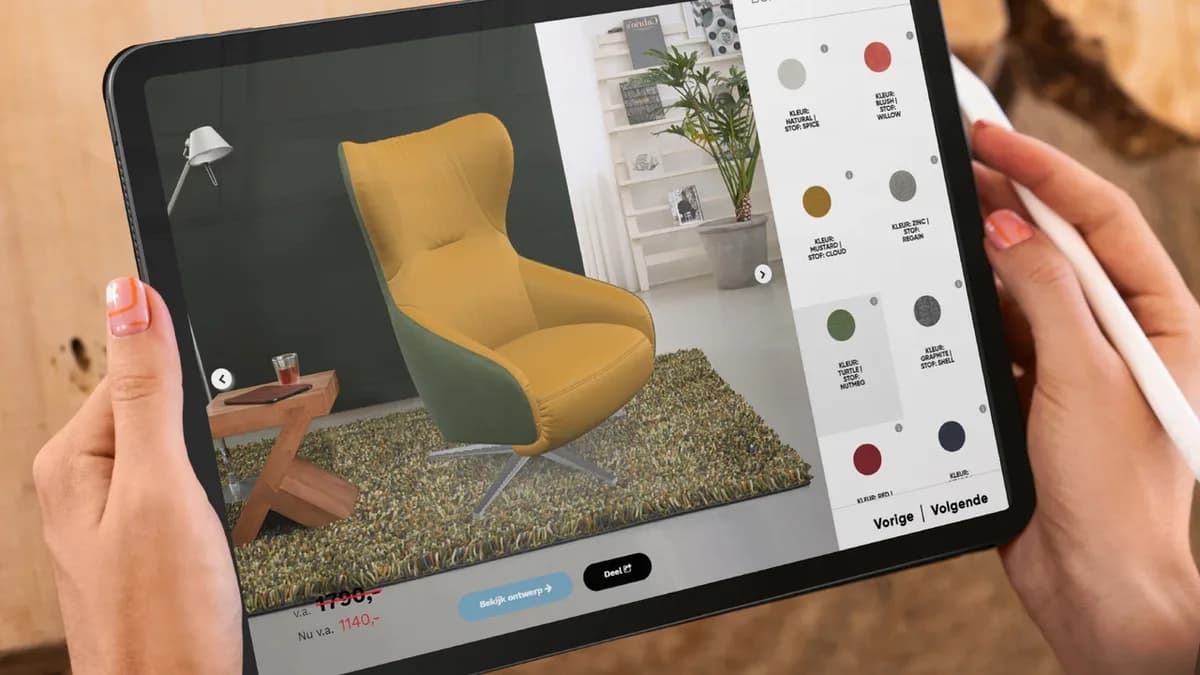
Variants. This is the decisive one. A sofa in twelve fabrics is twelve photo shoots and twelve sets of retouching. As a model it is one asset plus twelve material swaps, and the thirteenth fabric next season costs almost nothing. If your catalogue is combinatorial, the shoot option is not just expensive, it is usually not done at all, which is why so many product pages show one colour and a swatch grid.
Products that change. A new leg, a redesigned handle, a different finish. Photography means a reshoot. A model means a revision that takes a fraction of the time.
Multiple output formats from one source. The same asset produces product page images, an interactive viewer, phone AR, campaign renders, email images and print. It has no resolution limit, so the web thumbnail and the trade-show banner come from the same file.
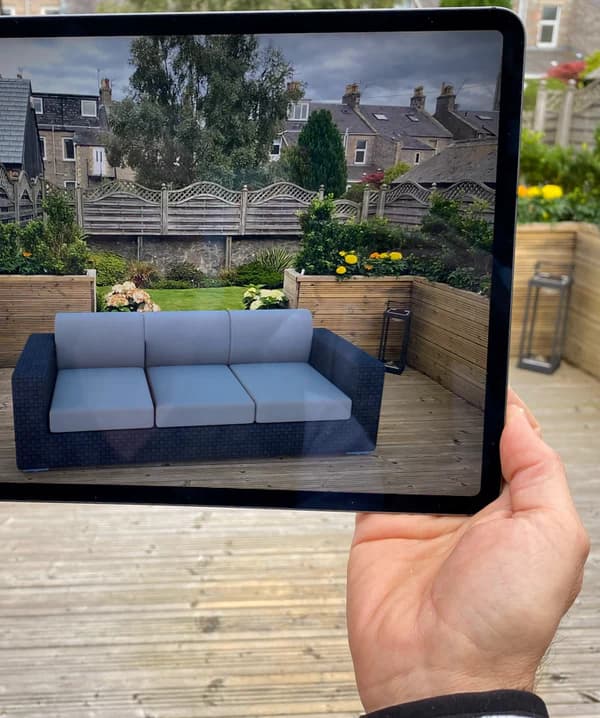
Scenes you cannot physically shoot. Garden furniture in a summer garden, photographed in February. A stove installed in six different living rooms. A product that has not been manufactured yet.
Consistency across a catalogue. Same camera, same lighting, same file, every time.
AR, which photography cannot do. A correctly scaled model handed to Scene Viewer on Android or Quick Look on Apple devices lets a shopper stand the product in their own room. There is no photographic equivalent.
The crossover, in a table
| Situation | Cheaper option |
|---|---|
| One product, one shoot, no variants, no changes | Photography |
| Human models or busy lifestyle scenes | Photography |
| Needed within days | Photography |
| Three or more colourways or materials | 3D |
| Product refreshed every season or two | 3D |
| Images needed for web, ads, email and print | 3D |
| Scene is impossible or out of season | 3D |
| Shopper needs to judge real size before buying | 3D, there is no alternative |
The hidden costs on both sides
On the photography side: sample logistics, reshoots triggered by a late product change, and the fact that a missing variant image usually means the variant never gets promoted. None of these appear as line items.
On the 3D side: a weak model is expensive because it fails everywhere at once, in the ad, on the product page and in print. A slow file is a conversion problem, which is why Google recommends staying under 10 megabytes and Shopify advises that an ideal GLB is about four. And if nobody owns render requests, the marketing team keeps booking shoots out of habit and you pay for both.
What we charge
We price per product per month rather than per model, because catalogues change and nobody should have to find budget for a re-shoot when a fabric is discontinued. The current plans:
| Plan | Price | Includes |
|---|---|---|
| Basic | 10 dollars per product per month, 12-month term | 3D asset creation, web 3D and AR integration, CDN hosting, yearly updates |
| Value | 20 dollars per model per month, 24-month term | Everything in Basic plus custom dimensions, annotations, five rendered product images and a 360 render viewer |
| Enterprise | Custom | Volume pricing, custom integrations, dedicated support |
All plans start at a minimum of 100 products or variants. Hosting and delivery are inside the fee, so there is no separate infrastructure bill.
The comparison to run is straightforward. Take one product with several variants, add up what photographing all of them properly would cost you including sample logistics and the reshoot you did last year, and set that against 240 dollars a year on the Value tier for a model that also gives you a viewer, AR and renders. For single-variant products that are photographed once, the arithmetic will often favour the shoot, and we would rather say so than pretend otherwise.
The revenue side, with sources
Cost is only half the case. Shopify's merchant data from 2020 showed product interactions involving 3D or AR content converting 94 percent more often than comparable products without it. Rebecca Minkoff, after adding 3D and AR to more than 50 product pages, reported shoppers who viewed a product in AR were 65 percent more likely to purchase, and that viewing a 3D model made shoppers 44 percent more likely to add to cart. Shopify also reports that Oakywood, after adding 3D configuration, went from months with almost no custom orders to roughly 200 to 300 a month, with average order value up 458 percent in Germany, 232 percent in Switzerland and 84 percent in the United Kingdom.
Those are specific merchants in specific categories, not a promise. The returns side has a large pot behind it too: the National Retail Federation and Appriss Retail put United States returns at 743 billion dollars in 2023, 14.5 percent of sales and 17.6 percent online.
How our clients use it
MELIMELI drives both the configurator and the marketing imagery from the same sofa models, so a new fabric is a material swap rather than a shoot. Sweef covers a range of modular layouts that could not realistically be photographed exhaustively. Contura uses the models to place stoves in customers' rooms at real size, which is a thing no photograph does. The solutions page has the full range.
If you want to check the arithmetic on a real product rather than in the abstract, pick the one with the most variants and we will build it in 3D for free, so you can compare the output against what your last shoot of the same item produced. Send us one product.
Sources
- Shopify, merchant data on 3D and AR content, September 2020, AR shopping, and 3D ecommerce for the Oakywood, add-to-cart and file-size figures.
- National Retail Federation and Appriss Retail, 2023 Consumer Returns in the Retail Industry.
- Google, Scene Viewer.
- Apple, AR Quick Look.