Other5 min read
Smart mirrors in retail: what they actually do, what they cost, and when a phone is better
In-store smart mirrors explained: the real capabilities, the hardware and running costs, the privacy problem, and the cases where they beat a shopper's phone.
By CharpstAR · 4 Oct 2023 · Updated 22 Sept 2026
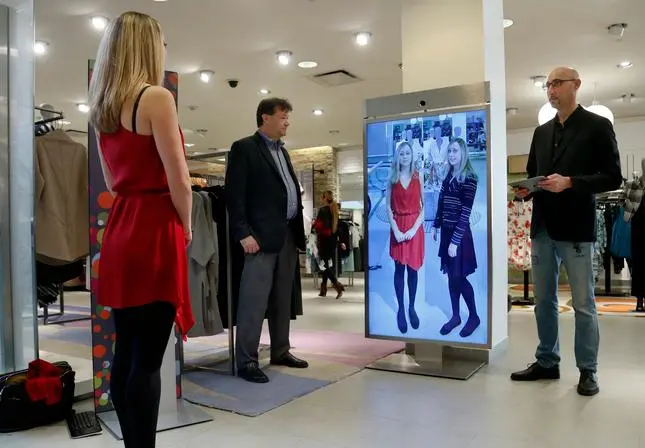
A smart mirror is a large touchscreen with a camera behind a mirrored surface, installed in a fitting room or on a shop floor. Depending on the model it recognises the garments a shopper has carried in, shows stock and sizes, calls a staff member for a different size, overlays products on the reflection, and sometimes takes payment.
The idea has been demonstrated at trade shows for well over a decade and installed in a modest number of stores. It works. Whether it is worth the money in your stores is a narrower question than the vendor literature suggests, and this article is an attempt to answer it plainly. We build 3D and AR for the web rather than mirrors, so we have no hardware to sell you here.
What a smart mirror really does
Strip out the marketing and there are four distinct functions, which vendors bundle but which have very different value.
Product recognition. RFID tags in the garments tell the mirror what the shopper brought in. Shopify's retail guide draws this distinction explicitly: in-store smart mirrors rely on RFID tags to recognise physical products, whereas online virtual fitting rooms work from cameras and software. This is the most reliable function and the least glamorous.
Information and stock. Once the mirror knows what you are holding, it can show other sizes, other colours, fabric details and whether the size you want is in the stockroom.
Service calls. Request a different size without getting dressed and walking out. Store staff get a notification. In practice this is the feature shoppers actually use.
Virtual overlay. Trying items on digitally against the reflection. EuroShop's write-up describes mirrors with touchscreens, cameras and RFID that allow virtual try-on without changing clothes, and mentions units such as a 32-inch frameless touch display that doubles as a virtual shelf, advisor and payment station. This is the function most often demoed and least often relied on, for the same reason garment try-on is weak on a phone: fabric on a moving body is hard.
What it costs
Nobody publishes a clean price, because deployments are quoted. What can be said honestly is the shape of the cost.
| Cost line | Notes |
|---|---|
| Hardware | The mirror unit itself. EuroShop's overview lists cost as one of the main drawbacks, describing acquisition and implementation as still relatively expensive |
| Installation | Power, network and mounting in every fitting room, usually outside trading hours |
| RFID tagging | Tagging the range, and keeping it tagged, is an ongoing operational change rather than a one-off |
| Software licence | Software-only virtual fitting room tools on Shopify's list run from about 129 to 549 dollars a month, which is a useful floor for the software element although mirror platforms sit above it |
| Content | 3D assets, product data and imagery have to exist and stay current |
| Maintenance | EuroShop notes touchscreens need regular maintenance; a dead mirror in a fitting room is worse than no mirror |
The market itself is small but growing. EuroShop cites a global smart mirror market of roughly 1.8 billion dollars in 2024, projected towards 6 billion by 2034, around 13 percent a year. That is a real market and it is not a mass-deployment market.
The privacy problem
A camera in a fitting room is the single biggest obstacle, and it is not a technical one. EuroShop lists data protection as a core challenge, and in Europe you are dealing with GDPR consent, signage, retention rules and, if the system recognises faces, biometric data with a much higher bar. Vendors have answers, mostly on-device processing and no retention, but you will need your own legal sign-off and clear signage, and some shoppers will object regardless. Budget for that conversation before the hardware.
When a mirror beats a phone
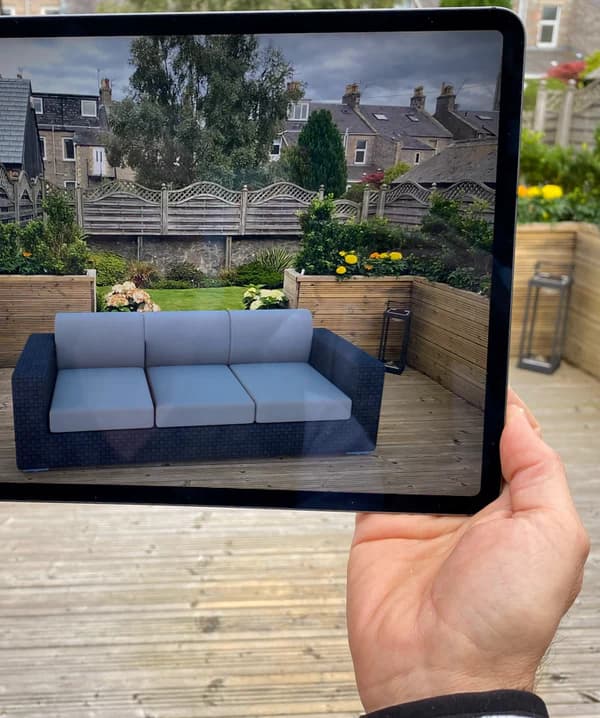
The phone is a serious competitor, and mostly it wins: the shopper owns it, it is already in their hand, it needs no capital expenditure, and it works at home where most browsing happens. A mirror earns its place in a few specific situations.
When the shopper is undressed and the phone is not to hand. The service call, the different size, the stock check. This is the strongest genuine case and it barely needs AR at all.
When the product is too large to bring to the shopper. Furniture, appliances, kitchens, stoves. A big in-store screen that shows the whole range in 3D is doing the job of floor space you do not have. Here a large display is genuinely better than a small one.
When the store is a showroom rather than a stockroom. Ranges too broad to stock, where the store's job is specification rather than take-away.
When the brand experience is the point. Flagships and high-end stores, where the mirror is partly marketing and is budgeted as such. That is a legitimate reason, as long as everyone says so out loud.
Against that, a mirror loses when the shopper is at home, which is most of the time, and when the question is whether something fits their room rather than their body. A phone with AR answers that one and no mirror can.
The part that applies either way
Whichever screen you choose, the expensive input is the same: accurate 3D models of your products, with real dimensions and honest materials. Those feed a mirror, a website viewer, a phone AR button and your rendered imagery from one file. Buying a mirror without that content is buying a frame for an empty picture.
That is the work we do. Sweef uses it for a modular sofa configurator, MELIMELI for a fabric picker across a sofa range, and Contura for stove placement in the customer's own living room. The models are the same assets a store screen would use.
How to decide
Run the smallest honest test. One store, the fitting rooms in one department, three months, and two numbers agreed in advance: conversion in that department against a comparable store, and the rate at which staff are called for a size. If the mirror is mostly delivering service calls, you have learned something valuable and cheap, because that function can often be delivered by a button and a tablet at a fraction of the cost.
And before any of it, make sure the online side is doing its job, because that is where the volume is. If your products are still represented only by photographs, we will model one for free so you can see what the asset looks like before you commit to anything: free sample. What we build is set out on the solutions page, with costs on the prices page.