3D for e-commerce5 min read
3D catalogues for B2B and wholesale: dealer portals, trade fairs and one model behind all of them
How a single 3D model can serve a wholesale catalogue, a dealer portal and a trade fair stand, and what B2B needs that consumer pages do not.
By CharpstAR · 22 Sept 2026

Most writing about 3D product visualisation assumes a consumer on a phone. B2B is a different customer with a different problem, and in some ways a better fit for the technology, because a wholesale buyer places larger orders from a bigger catalogue with less opportunity to see the goods.
A dealer ordering a season of stoves or a contract buyer specifying two hundred chairs for a hotel is making high-value decisions from a PDF. That PDF costs a fortune to produce, goes out of date the week it is printed, and shows a fraction of the range.
What B2B buyers need that consumers do not
| Need | Consumer page | B2B catalogue |
|---|---|---|
| Specifications | Nice to have, often skipped | Load ratings, materials, certifications, packing dimensions, all required |
| Pricing | Public, one price | Tiered by account, often hidden until login |
| Volume | One item | Order lines by the dozen, across variants |
| Who is looking | The buyer | A buyer, a specifier, an architect, sometimes an end client they are presenting to |
| Session length | Minutes | Repeated visits over weeks |
| The deciding question | Will this suit me | Will this suit my customers, and can I sell it |
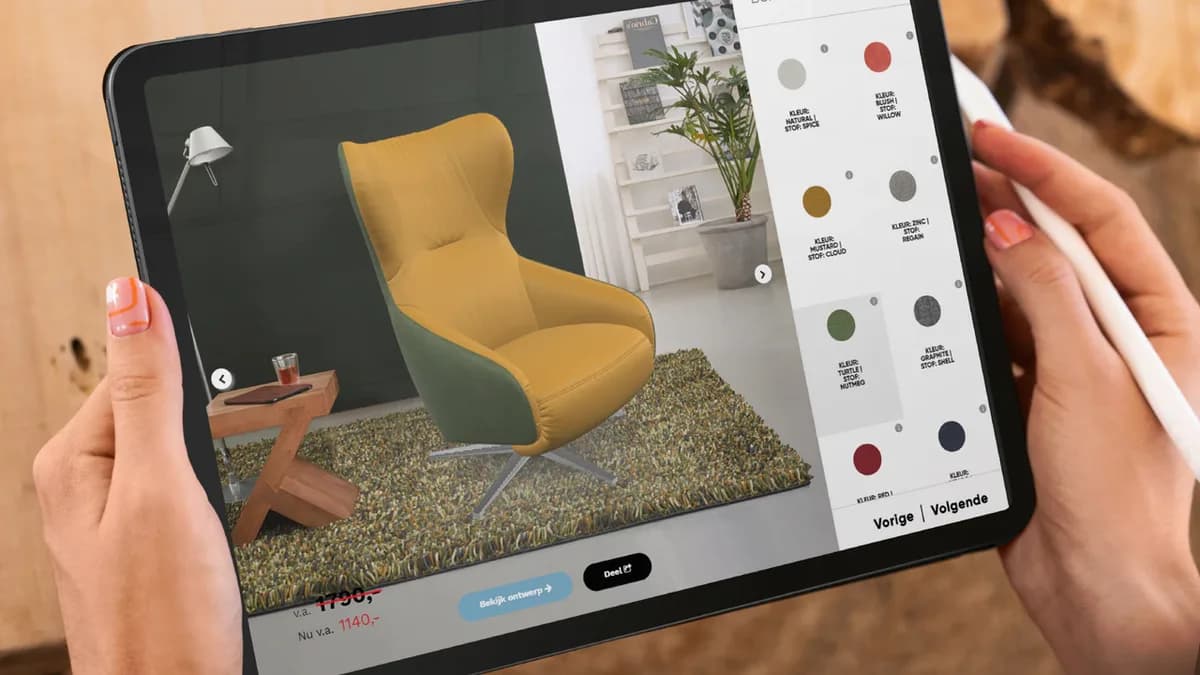
That last row is the one that changes the design. A dealer is not asking whether they like the sofa. They are asking whether they can sell it, which means they need to be able to show it to someone else. A 3D model is far better for that than a page in a binder, because the dealer can spin it on a tablet in front of a customer.
One model, four surfaces
The commercial case for 3D in B2B is asset reuse. A model built once can carry:
The dealer portal. Every variant viewable and specifiable without a sample. This is where the catalogue cost actually falls, because a portal updates instantly and a printed catalogue does not update at all.
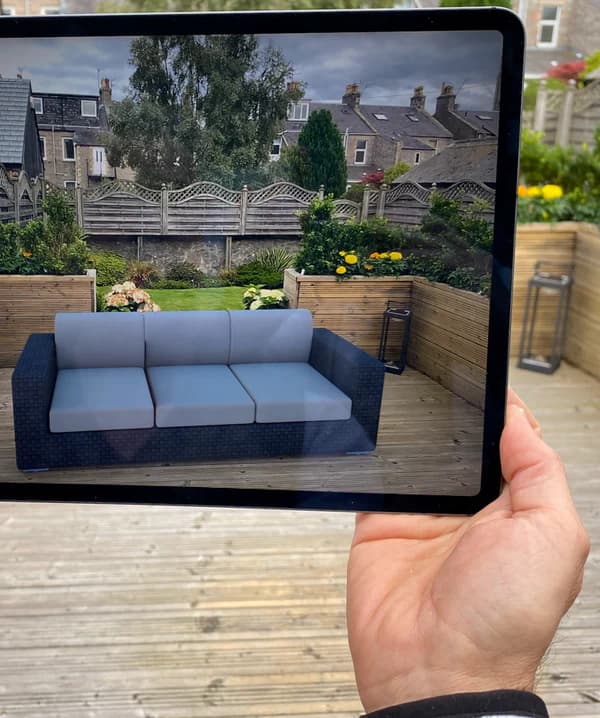
The trade fair stand. A stand can physically hold perhaps a dozen products. A screen or a tablet on that stand holds the whole range, and AR lets a visitor place a product in a space they photograph. The stand stops being a limit on what you can show.
The dealer's own selling. Contura built Build Your Stove for a variation-heavy range and it is used in store as well as online. That is the important detail for a wholesale business: the tool you build for your dealers becomes a tool your dealers use on their own customers, which makes you easier to stock.
Consumer-facing marketing. Renders, lifestyle images and product page assets come out of the same models, so the spend is not stranded in a portal that only three hundred accounts ever see.
That reuse is why the per-model cost of a B2B programme looks better than the headline number suggests. You are not buying a catalogue, you are buying the source that the catalogue, the stand and the marketing images all come from.
Finish
Log store
Floor plate
A variation-heavy product in one model. For a dealer, the options are the catalogue, and this is quicker than any page of them.
What a 3D wholesale catalogue has to get right
Specifications attached to the model, not to a separate PDF. If the buyer has to leave the viewer to find the packing dimensions, they are back in the PDF world. Dimensions, materials, weight, certifications and packing data belong on the item.
Variant coverage rather than hero products. A consumer page can show the best-selling colour and get away with it. A dealer ordering a season needs all of them, because they are choosing an assortment. This is the main reason B2B catalogues are larger modelling projects than consumer ones, and it is why our Basic tier sets a minimum of 100 variants at 10 dollars per product per month on a twelve-month term. Catalogue breadth is the normal shape of this work.
Works on a tablet, offline-tolerant. Trade fair wifi is bad, and a sales visit may have no connection at all. Assets that are too heavy to cache or that fail without a live connection are useless in exactly the situations where the dealer most needs them.
Access control that matches your pricing. Tiered pricing behind login, public specifications in front of it, if that is your model. Deciding this early avoids rebuilding the portal.
A real export path. A specifier working in CAD wants geometry they can drop into a floor plan. A marketing team wants renders. A dealer wants a shareable link. One source, several outputs.
The evidence, and its limits
There is no good published data on 3D catalogues in wholesale specifically. The numbers that exist are consumer-side. Shopify reported in 2020 that interactions with products carrying 3D or AR content converted 94 percent more often than comparable products without, and merchant results in their AR shopping write-up show a 65 percent purchase lift for Rebecca Minkoff on AR-enabled pages.
Applying those directly to B2B would be wrong. A dealer buying a season is not an impulse shopper, and conversion is not the metric a wholesale team cares about. The metrics that matter in B2B are assortment breadth per order, sample requests, and how much of your sales team's time is spent answering specification questions. Those are measurable inside your own business, and they are the ones to baseline before you start.
A realistic first phase
Do not model the catalogue in one go. Take the range that generates the most sample requests, model every variant of it, and put it in front of twenty dealers with the old PDF still available. Then count sample requests, specification emails and the assortment breadth of the orders that come in.
If dealers order more of the range and ask for fewer samples, you have your answer and a number to build the business case on. If nothing moves, you have spent one range rather than a catalogue finding that out.
Pricing is per product per month, which suits this shape of project: Basic from 10 dollars per product per month on a twelve-month term with a minimum of 100 variants, Value from 20 dollars per model per month on a twenty-four-month term where products need configuration, Enterprise quoted for a full catalogue programme. Our solutions page sets out what each includes.
Pick the product your dealers ask the most questions about. Send it to us and we will build the model free, for you to keep.
Sources
- Shopify, merchant data on 3D and AR content, September 2020.
- Shopify, AR shopping.