Fashion6 min read
Beauty returns and virtual try-on: what it fixes and what it cannot
Why beauty gets returned, which of those reasons try-on actually addresses, and the two it will not touch: skin tone accuracy and product texture.
By CharpstAR · 22 Sept 2026
Beauty is an unusual e-commerce category for returns. Much of what gets sold cannot be sent back at all once it is opened, for hygiene reasons, so the return rate on a beauty catalogue understates the problem badly. The real cost shows up somewhere else: in the customer who bought the wrong shade, could not return it, and did not come back.
That is the number worth protecting, and it is the one virtual try-on is sold as fixing. It fixes part of it. This article is about which part.
We should say where we stand. We build 3D models, product viewers, configurators, web AR and eyewear virtual try-on. We do not build face try-on for makeup. Nothing here is an attempt to sell you one.
Why beauty products come back, or quietly go unused
Sort the reasons and they fall into four groups.
The shade is wrong. The foundation is too pink, the nude is too brown, the lipstick that looked warm online is cool on. This is the largest group by a distance and the one everyone means when they talk about beauty returns.
The texture or finish is wrong. It is the right colour but the wrong feel: a cream that sits heavy, a matte that looks chalky, a foundation with more coverage than expected.
The product was not what the shopper thought it was. Wrong size, wrong applicator, a travel format when they expected the full one. This is a product-page problem, not a try-on problem.
It did not suit them for reasons the picture could not carry. Fragrance, sensitivity, how it wore through a day.
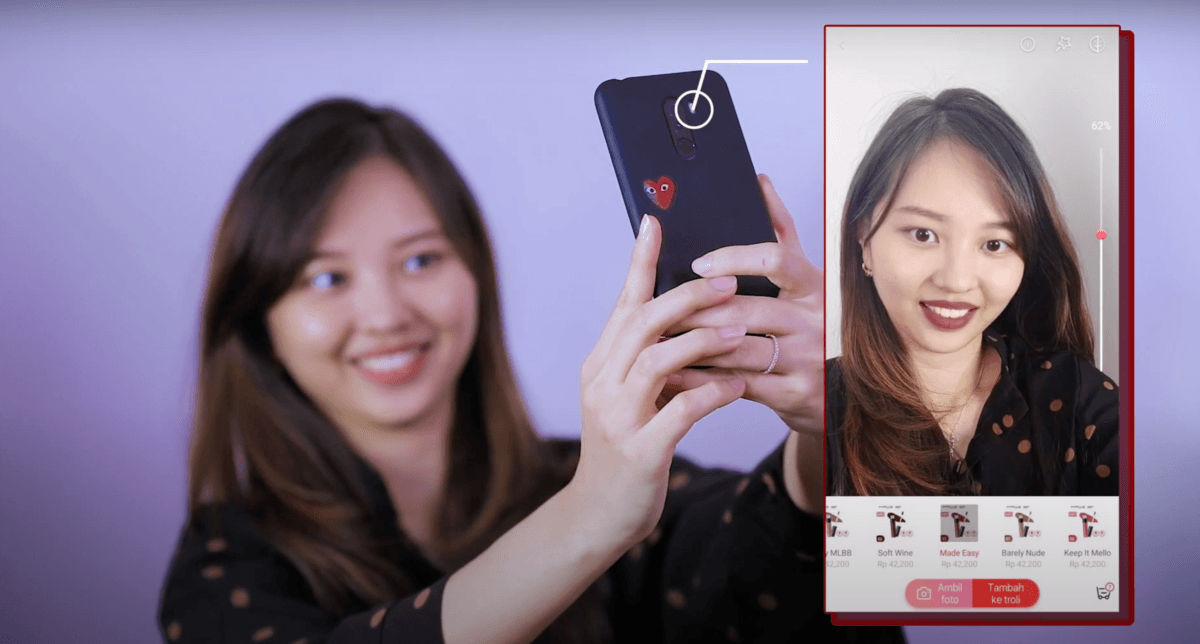
Try-on speaks directly to the first group, partly to the fourth, and not at all to the second and third.
For scale, what returns cost across retail
Beauty-specific return data is scarce and mostly vendor-published, so the honest anchor is the industry number. The National Retail Federation, with Appriss Retail, put total United States returns at 743 billion dollars in 2023, about 14.5 percent of retail sales. Beauty sits below that average on measured returns, for the hygiene reason above, and above it on the hidden version: product bought, disliked, never repurchased.
If you want a figure you can use internally, do not go looking for a beauty return benchmark. Measure your own repeat purchase rate on shade-dependent products against your non-shade products. The gap is the size of your problem.
What try-on genuinely changes
Three things, reliably.
It removes the paralysis of a long shade range. A grid of thirty foundations is a reason to close the tab, and a shopper with three candidates buys far more often than one with thirty.
It answers placement and shape questions exactly. How wide a brow product reads, where a liner sits, whether a blush placement works on a particular face. These are geometry, and face tracking handles geometry well.
It builds enough confidence to buy at all. Shopify's merchant data from September 2020 found that interactions with products carrying 3D or AR content converted 94 percent more often than comparable products without it. That is across categories, not beauty specifically, but the mechanism is the same: a shopper who has seen the product in context commits more readily.
What it cannot do: skin tone
Here is the limit that matters most, and it is not a software maturity problem that will be fixed next year.
A makeup try-on shows a colour on screen. Between the real product and the shopper's eye sit four uncontrolled variables: the phone camera's sensor and its automatic white balance, the ambient light in the room, the shopper's own screen and its colour profile, and the accuracy of the digital swatch itself. Each introduces error, and they compound.
For a bright red lipstick that hardly matters, because nobody is judging a millimetre of hue. For foundation it matters completely, since the entire decision is whether a shade disappears into a specific skin tone. Undertone is a comparison between two colours, and if either one has drifted the comparison is meaningless.
The consequence is practical. A shopper can use try-on to decide that a foundation range is worth trying and which two shades to consider. They cannot use it to be sure. Any vendor promising shade certainty on a phone camera is selling past the physics.
There is a documented signal here too. In Shopify's AR shopping write-up, facial complexion products carry the highest difficulty scores at 41 percent, ahead of self-tanning and body makeup at 38 percent each. The hardest category to shop online is exactly the one the camera is worst at.
What it cannot do: texture
The second limit gets less attention and causes just as much quiet disappointment.
Try-on renders colour and, at best, an approximation of finish through a specular highlight. It does not communicate weight, slip, how a cream feels going on, whether a powder grabs, how a formula behaves after six hours. Those are the reasons a shopper who got the right shade still stops using the product.
No camera solves this. What helps is boring and effective: swatch photography on a range of real skin tones, wear-test video, coverage and finish stated in words, and reviews filtered by skin type. That is a content problem, and it is cheaper than a try-on integration.
A realistic split of the problem
| Shopper question | Best tool | Why |
|---|---|---|
| Which shades in this range are plausible for me? | Virtual try-on | Fast narrowing of a long range |
| Is this exactly my shade? | Swatches on real skin tones, samples, reviews | Camera and screen colour error compounds |
| How does it feel and wear? | Wear-test video, written finish and coverage, reviews | Not renderable |
| What size, format and applicator is this? | 3D model in the page | Exact geometry at real scale |
| Does this tool, device or brush suit my hand? | 3D model with dimensions, AR at real size | Scale is the whole question |
The bottom two rows are the ones brands skip, and they are the cheapest wins in the table. A beauty catalogue is full of products where the question is physical rather than chromatic: styling tools, devices, brush sets, refill systems, gift boxes. A shopper rotating one in the page and seeing it at real size gets an exact answer, with none of the colour uncertainty above.
What a 3D model does that a photo does not
This is the part we can speak to from our own work, though our clients are in furniture and home products rather than beauty. When MELIMELI moved its upholstery range onto a configurator, a new fabric stopped being a photo shoot and became a texture applied to an existing model. The same logic transfers directly to a beauty range with many finishes or packaging variants: build the object once, then generate every variant from it.
Contura shows the scale side. Customers place a wood-burning stove in their own room at true size before ordering, and the size question that used to reach a dealer settles itself. Any beauty product where a shopper has misjudged how big it is has the same problem and the same fix.
What we would do if we ran a beauty site
Put try-on on shade-dependent colour products and be honest in the copy about lighting. Put real swatches on a range of skin tones next to it, because that is what converts the shopper who is nearly sure. Add wear-test content for texture, since nothing renders it. And build 3D models for everything where the question is physical rather than chromatic, because that answer is exact and it is the part most beauty sites have not touched.
The last one we will do for free, once, so you can judge it on your own page. Send us one product and the model is yours to keep. The solutions page shows what else we build, and prices are published.
Sources
- National Retail Federation and Appriss Retail, 2023 Consumer Returns in the Retail Industry.
- Shopify, AR shopping, including complexion-product difficulty scores.
- Shopify, merchant data on 3D and AR content, September 2020.