Beauty6 min read
Shade finders in beauty: quiz, camera, or both, and what actually converts
The two ways brands help shoppers pick a shade, what each one costs in accuracy and privacy, and how to tell whether yours is earning its place.
By CharpstAR · 22 Sept 2026
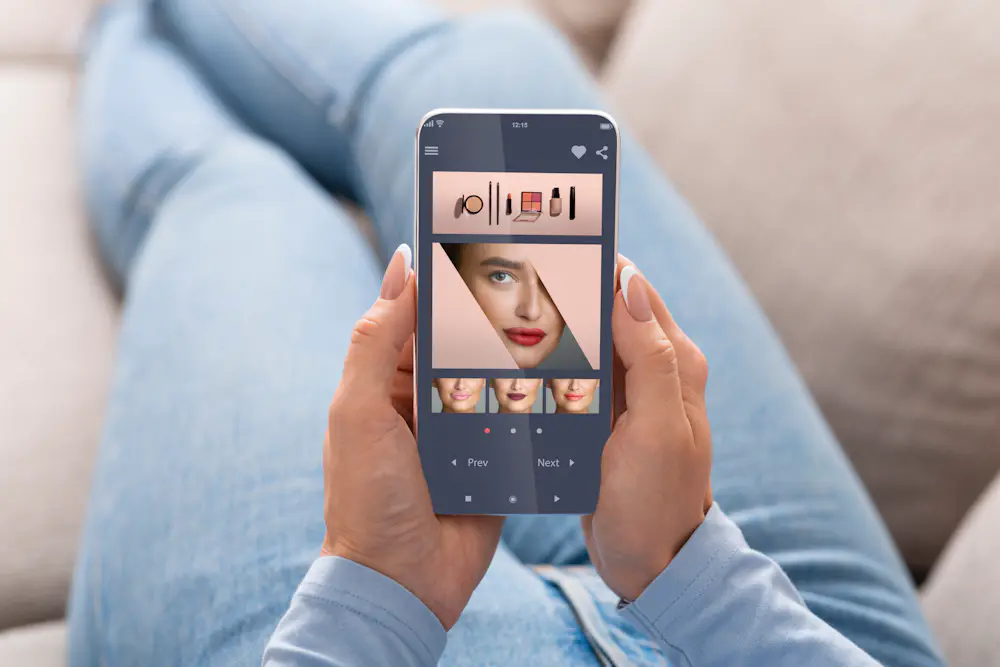
Every beauty brand with more than a dozen foundation shades eventually builds a shade finder. There are two ways to do it. You can ask the shopper questions, or you can point a camera at them. Both are sold as personalisation. They behave very differently, and the choice has consequences for accuracy, for privacy law, and for how many people finish the flow at all.
We build 3D models, product viewers, configurators, web AR and eyewear virtual try-on. We do not build makeup face try-on or camera-based skin tone analysis, so we have nothing to sell you at the end of this comparison. What we do have is years of watching which product-page tools shoppers finish and which ones they abandon.
The quiz approach
A shade quiz asks four to eight questions. What brand and shade do you currently wear. Does your skin look better in gold or silver jewellery. How does your skin react to sun. Which of these three wrists looks most like yours. Then it maps the answers onto your range.
Its strengths are real and underrated. It works on any device with no camera permission. It is cheap to build and to change. It captures information a camera cannot see, such as which competitor product the shopper already wears, which is often the single most predictive input you can get. And the output can be explained: you told us X, so we suggest Y.
Its weakness is that people are bad at describing their own skin. Self-reported undertone in particular is close to a coin flip, and a quiz built mostly on self-report inherits that error.
The camera approach
A camera shade finder photographs or live-tracks the face, locates skin regions away from the lips and eyes, and estimates a tone and undertone from the pixels. Some products also overlay the suggested shade so the shopper can see it.
The strength is that it measures instead of asking. When the lighting is good and the reference is handled properly, it beats self-report.
The weakness is the same one that limits every camera-based beauty tool. The phone camera applies its own automatic white balance and exposure before your code sees a frame, the ambient light is unknown, and the shopper's screen has its own colour profile. The usual mitigation is to ask the shopper to hold a known reference in frame, a white card or in some implementations a specific credit card, or to face a window. Each of those steps costs you completions.
There is a signal in the data about how hard this category is. Shopify's write-up on AR shopping reports that facial complexion products carry the highest difficulty scores at 41 percent, ahead of self-tanning and body makeup at 38 percent each. Complexion is the hardest thing to buy online and also the thing the camera is worst at measuring reliably.
The comparison, plainly
| Shade quiz | Camera shade finder | |
|---|---|---|
| Accuracy ceiling | Limited by self-report | Higher, if lighting is controlled |
| Completion rate | High, no permission needed | Lower, camera prompt drops people |
| Works on desktop | Yes | Poorly |
| Privacy exposure | Low, ordinary preference data | High, biometric-adjacent |
| Build and change cost | Low | High |
| Explains its answer | Easily | Rarely |
The privacy part, which is not optional
This is where a beauty shade finder differs from a furniture configurator, and where teams get caught.
A photograph of a face processed to derive characteristics about a person is personal data under the GDPR in Europe. Depending on how the processing works and what is retained, it can fall into the special category rules that cover biometric data used to identify someone, which carries a much higher bar. In the United States, state biometric privacy laws, Illinois being the strictest, have produced real litigation against retailers over face-scanning features, including virtual try-on.
None of that means you cannot build one. It means three things have to be true before you do.
The processing should happen on the device wherever possible, with no image leaving the phone. That single decision removes most of the risk and is technically normal now.
If an image does go to a server, you need a clear legal basis, an explicit and specific consent prompt rather than a buried cookie banner, a stated retention period, and an actual deletion process behind it.
And your privacy notice has to say what happens in plain language, at the point where the camera opens rather than four clicks away. Shoppers who understand what is happening consent more, not less.
Get a lawyer in your markets to look at it. This is the one part of a beauty product page where a bad decision is expensive.
What actually converts
Having watched a lot of interactive product-page tools, the pattern is consistent and mostly unglamorous.
The tools that convert are the ones a shopper finishes. A camera flow with a permission prompt, a lighting instruction and a reference card has four places to lose people. A five-question quiz has one. If your camera finder is more accurate but half as many people complete it, the quiz is producing more correct purchases in absolute terms.
The tools that convert give an explicit recommendation, not a range. Ending on one suggested shade and one alternative beats ending on five equally weighted options. The shopper came to have a decision made.
The tools that convert let the shopper correct the result. A recommendation that cannot be nudged one step lighter or warmer feels like an argument.
And the strongest single input is prior product ownership. Asking what the shopper currently wears and translating it into your range outperforms almost everything else, because it replaces self-perception with a fixed reference. If you build only one thing, build that.
There is broader evidence that engagement with rich product content pays. Shopify's merchant data from September 2020 found interactions with products carrying 3D or AR content converted 94 percent more often than comparable products without, and in Shopify's AR shopping write-up, Rebecca Minkoff reported shoppers were 44 percent more likely to add an item to their cart and saw a 65 percent purchase lift on AR-enabled product pages. Those are not beauty shade finders, but they describe the same mechanism: a shopper who has interacted with the product buys more often.
The honest sequence
If you are starting from nothing, the order we would recommend is this.
Build the quiz first, weighted heavily on what the shopper already wears. Ship it in a week and measure completion and return rate.
Add real swatch photography across a wide range of skin tones, with the model's shade labelled. This is not personalisation and it converts better than most personalisation.
Then, if the quiz is completing well and you still have a shade problem, evaluate a camera finder as an addition rather than a replacement, and insist on on-device processing.
Finally, look at the part of your catalogue that has no shade question at all. Tools, devices, brushes, packaging, sets and refill systems are bought on size, shape and build quality, and those questions have exact answers.
Where our side of this fits
When MELIMELI moved an upholstery range into a configurator, adding a new fabric stopped meaning a new photo shoot and became a texture applied to a model that already existed. A beauty range with many finishes or packaging variants has the same economics. Sweef shows the choice-narrowing side: shoppers assemble the configuration they want themselves instead of emailing customer service. And Contura covers scale, with customers placing a stove in their own room before ordering.
That is the piece we would build for you. Send us one product and we will make the 3D model and put it in a live viewer, free, and you keep it whether or not anything follows: free sample. The solutions page shows the range and prices are public.