3D for e-commerce5 min read
3D product visualization in e-commerce: the four formats and when each one pays
Spin viewers, live 3D, configurators and AR are different tools for different products. A plain guide to which format fits which catalogue, with costs.
By CharpstAR · 21 Mar 2023 · Updated 22 Sept 2026
Part of 3D models for e-commerce: the complete guide
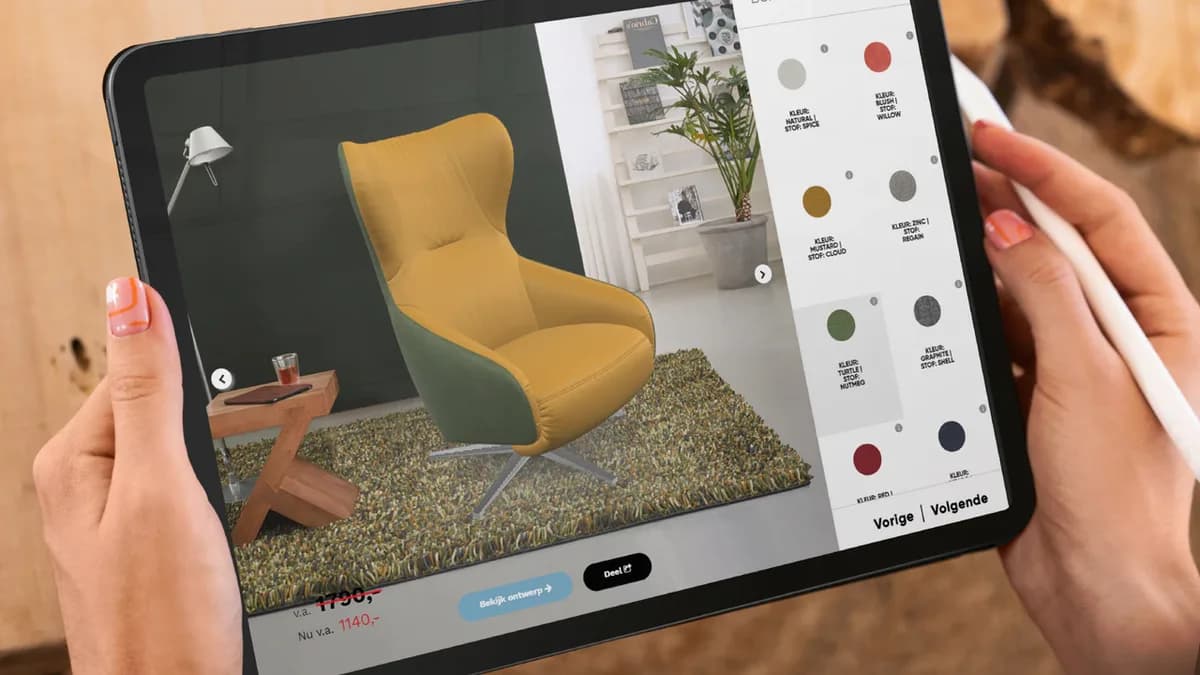
"3D product visualization" is a phrase that covers four quite different things, and vendors tend to sell whichever one they make as if it were the whole category. A shoe brand and a kitchen manufacturer both need 3D, but not the same 3D. This guide separates the formats, says what each is good for, and gives the honest cost and effort of each, so you can match the tool to the catalogue rather than the other way round.
The four formats
360 spin. A sequence of photographs, or renders, taken around the product, played back as the shopper drags. It looks like 3D and is not: there is no geometry, so no AR, no dimensions, no configuration. It is cheap if you already have a turntable, and it is the right answer for products that are small, single-variant and bought on looks: shoes, bags, small electronics.
Live 3D viewer. A real model in the page, rendered on the shopper's device. Rotate freely, zoom into materials, read dimensions, tap hotspots. This is the format that also feeds AR, because the same file is used. Right for anything with a size question or a "what is the back like" question: furniture, lighting, appliances, sports equipment.
Configurator. A live 3D viewer with rules. Change the fabric, the legs, the width, add a module, and the model and the price update. Right for products that are made to order or sold in many combinations, which is most upholstered furniture and most kitchens.
Augmented reality. The model placed in the shopper's own room through the phone camera, at real size, without an app in the modern web versions. Right for anything where "will it fit" or "will it suit the room" is the last question before checkout.
Which format for which product
| Product type | Buy on | First format | Add later |
|---|---|---|---|
| Shoes, bags, watches | Looks, detail | 360 spin or live 3D | AR try-on for glasses and watches |
| Sofas, beds, tables | Size, fabric, combination | Configurator | AR placement |
| Lighting, stoves, appliances | Size, finish, fit in room | Live 3D with dimensions | AR placement |
| Kitchens, wardrobes, modular storage | Combination, room fit | Configurator | AR, room planner |
| Outdoor furniture, plants, pots | Scale in a garden | Live 3D | AR placement |
The pattern: the more the shopper needs to know about size and combination, the further right you go. The more they buy on appearance alone, the more a spin does the job.
What it costs, honestly
A 360 spin is a day on a turntable per product, or a render pass if a model already exists. A live 3D model of a piece of furniture is about a working week of a 3D artist, most of it on materials. A configurator is that model plus the rules, the variant textures and the integration with your product data, which is a project measured in weeks for a range rather than days for a product. AR adds almost nothing once the model exists, because it is the same file exported for the phone.
The recurring cost is the part people forget. Products change, fabrics get discontinued, a new leg option arrives. A catalogue of models that nobody maintains is a catalogue of wrong models within a year. That is why we sell it as a monthly fee per product with updates included rather than a one-off build; the numbers are on the prices page.
What the numbers say
Shopify reported in September 2020 that interactions with products carrying 3D or AR content converted 94 percent more often than equivalent products without. Rebecca Minkoff saw a 44 percent lift in add-to-cart among shoppers who used the 3D viewer and 65 percent more purchases among those who used AR. Oakywood, a desk-accessory maker, moved to 3D scanning and configuration and reported average order value up 84 percent in the United Kingdom and more in Germany, because a configurator sells the options.
The returns story is about furniture. Online furniture returns run around 22.7 percent against a 19.3 percent all-category average, and about 58 percent of those returns are size and space mismatches. A viewer with dimensions and an AR placement attacks exactly that reason.
Two of our own examples
MELIMELI sells sofas whose fabric and configuration are chosen in a showroom. The configurator brought the showroom to the product page: every fabric on the real model, and photoreal renders generated from the same file for the category pages, so the site never shows a fabric that has not been modelled. Contura makes wood-burning stoves, where the question is whether this model, in this finish, suits this living room. Their AR configurator lets the shopper stand it in the corner at real size before a dealer is ever called.
What the "future" part actually looks like
The headline in the old version of this article promised that 3D was the future of e-commerce. The more useful claim is narrower. 3D is becoming the source file for everything else on the product page: the still photos are renders, the video is a turntable, the AR is an export, the category thumbnail is a crop. Brands that treat the model as the master asset and the photos as outputs stop paying for shoots every time a fabric changes. Google already lets merchants attach a 3D model to a product listing so it appears in Search with a "view in your space" option, in some markets and categories. Apple and Android phones open a 3D file straight into AR from a web link. The plumbing is there; the missing piece at most retailers is the models.
Where to start
Start with the format your product needs, not the most impressive one. A shoe brand that builds a configurator has bought the wrong thing. A sofa brand that builds a spin has bought half the thing. If you are not sure, pick one product and have it modelled properly; the model can become a spin, a viewer, a configurator or an AR file later, because they are all the same file. We do that first model free so the choice can be made with the thing in front of you. Send us one product.
Sources
- Shopify, merchant data on 3D and AR content, September 2020, AR shopping results, and 3D ecommerce guide with the Oakywood figures.
- Eightx, Furniture and home return rate benchmarks 2025.
- Google Merchant Center Help, Display your products in 3D and augmented reality.
- Apple Developer, AR Quick Look.